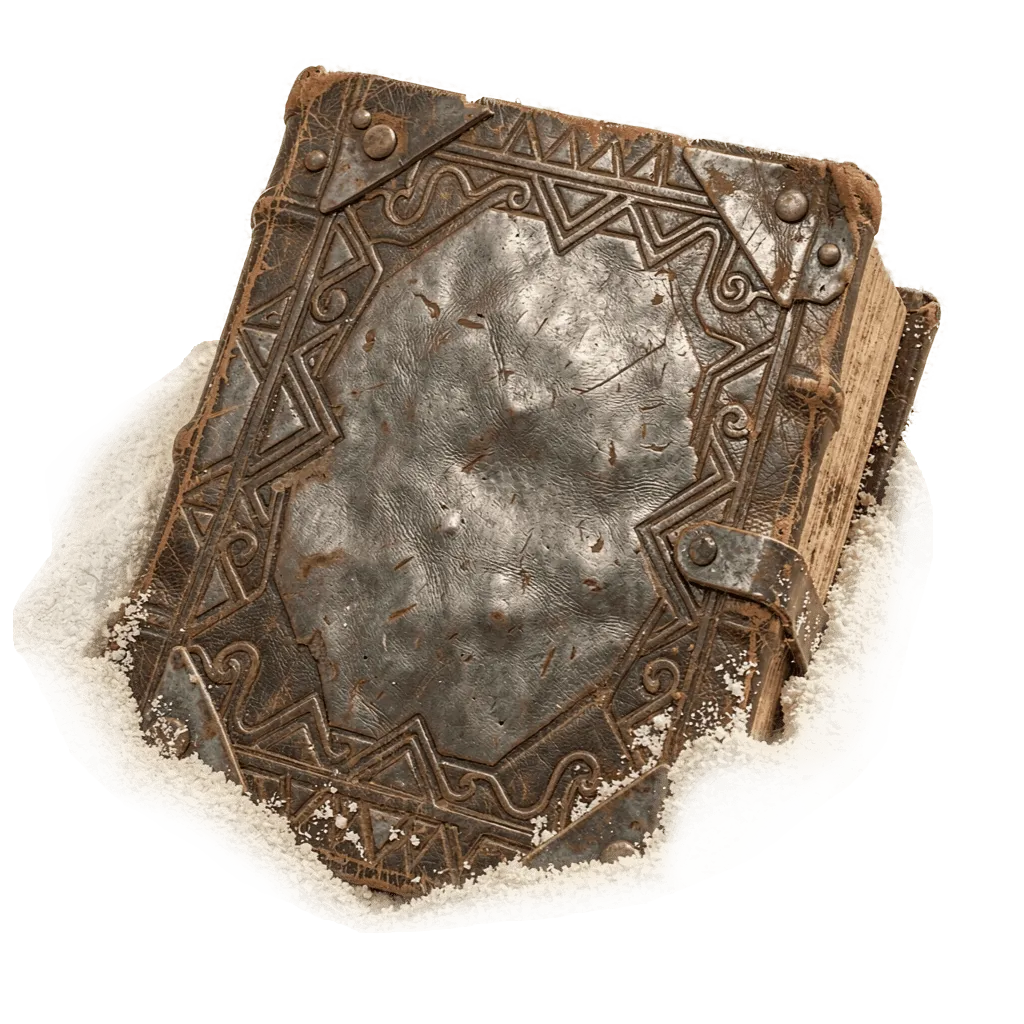
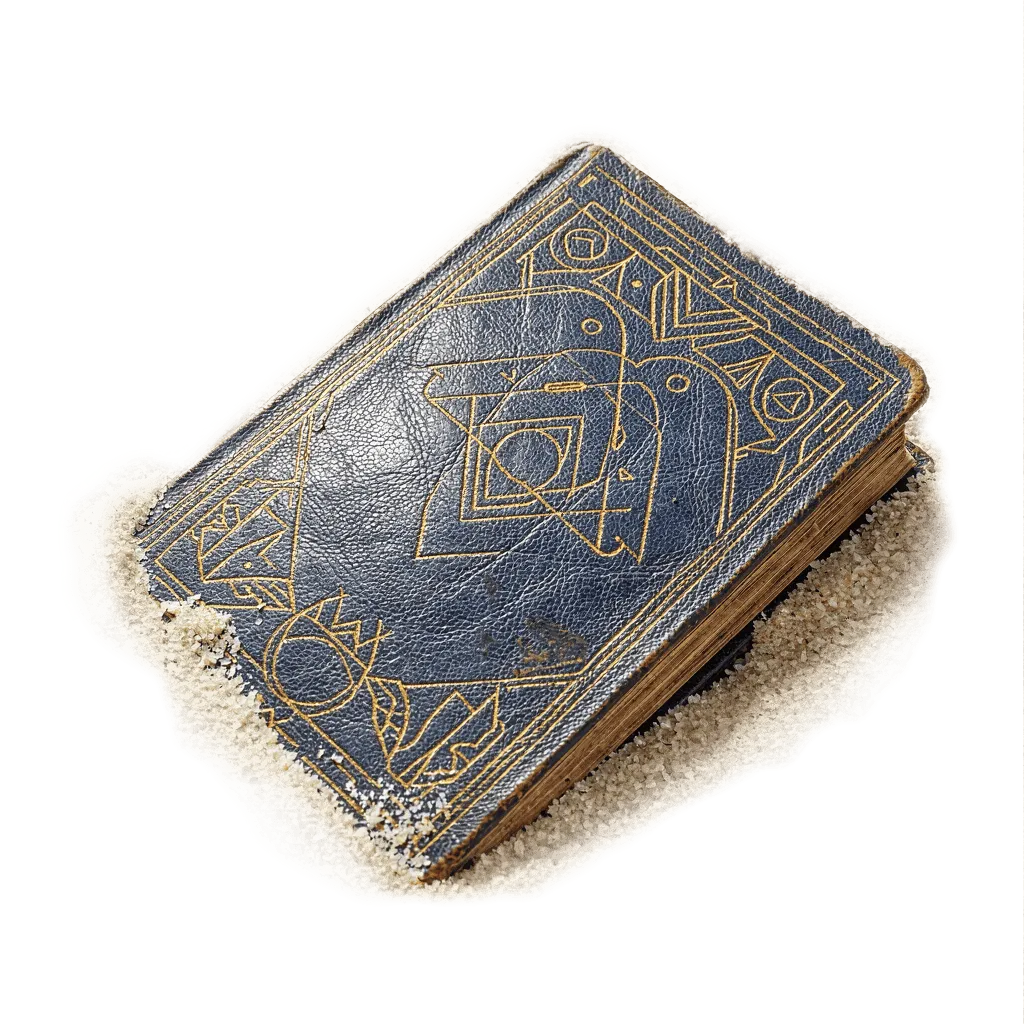
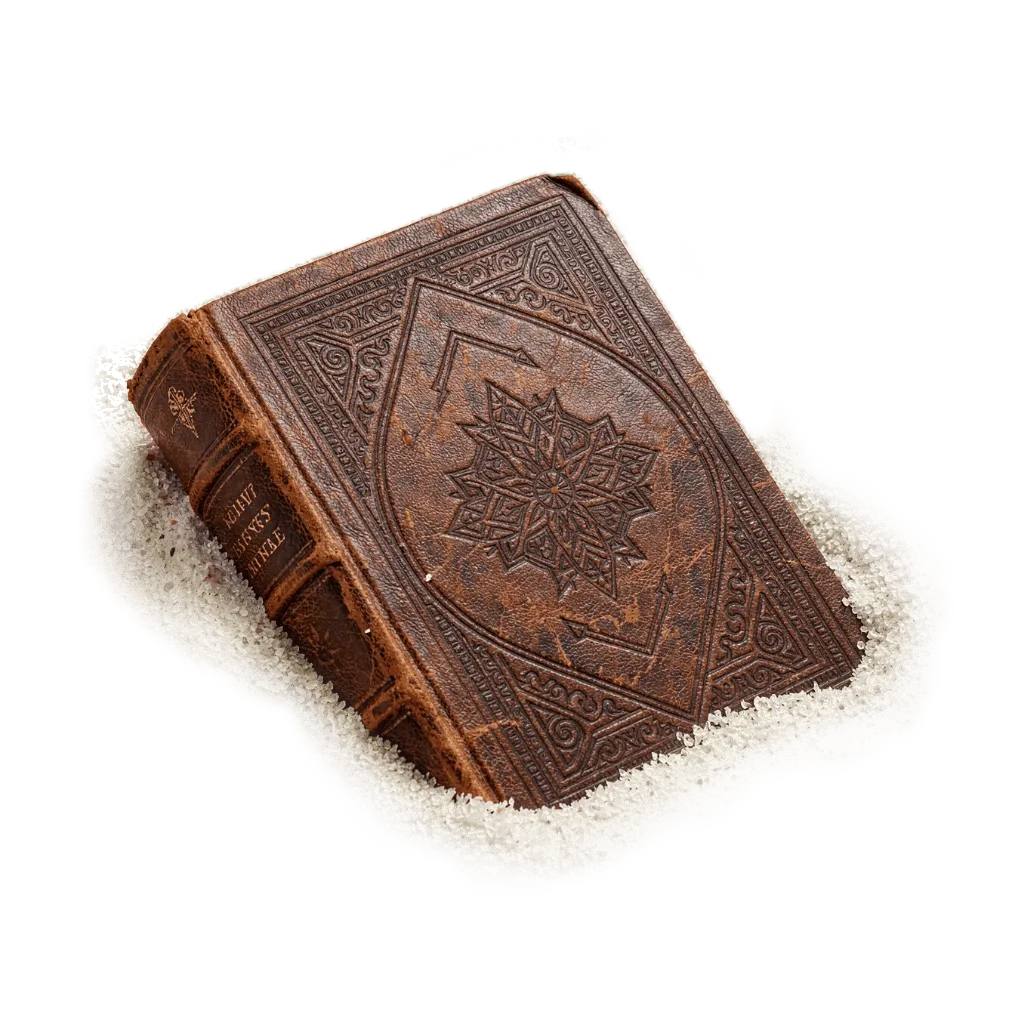

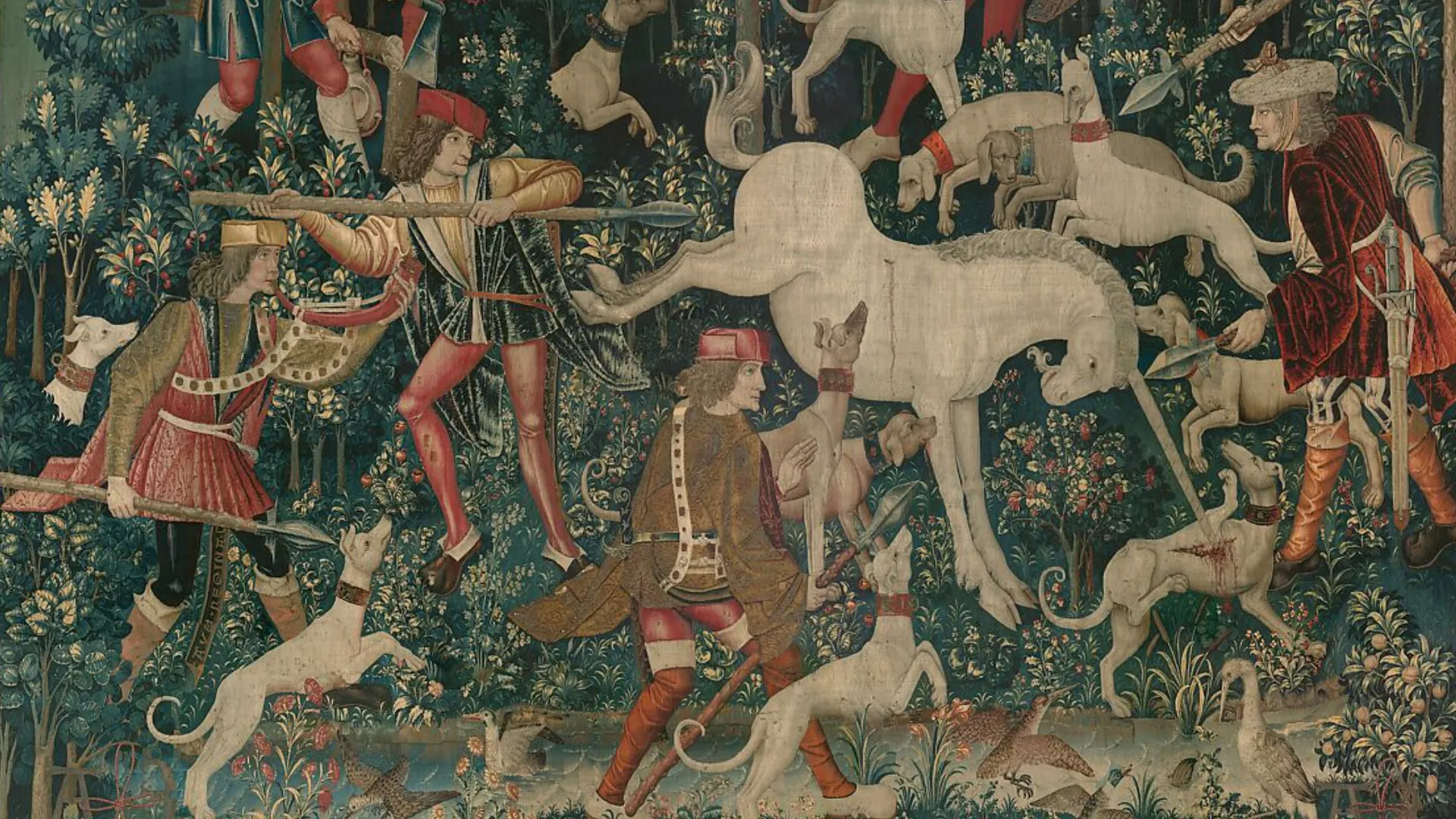
Wool for the body of the thing, silk where the light must catch, and silver and gilt worked into the weft wherever somebody could afford it. Seven hangings in all, woven in the Southern Netherlands around 1500, very probably to designs drawn in Paris, and they live today in the Cloisters, the Metropolitan Museum of Art’s medieval outpost at the northern tip of Manhattan. Together, they tell the story of the hunt for a unicorn, and in most of them somebody is trying to kill it.
I had expected something gentler, but that isn’t the history of the unicorn.
The hunt, panel by panel
The hunters enter the woods with their hounds. They find the unicorn at a fountain, dipping its horn into the water to purify it while other beasts gather round. They chase it across a stream. In the fourth hanging, which the museum calls The Unicorn Defends Himself, the creature turns on them, and it is not a pretty animal when it does.
Then comes the panel that ought to be the climax, in which a maiden lures the beast and it surrenders to her. Unfortunately, it survives only in two fragments, but I rather approve of that. The one moment in the sequence in which the unicorn is actually caught is the one moment time has declined to show us whole, which leaves a tantalising hole for the imagination to fill in.
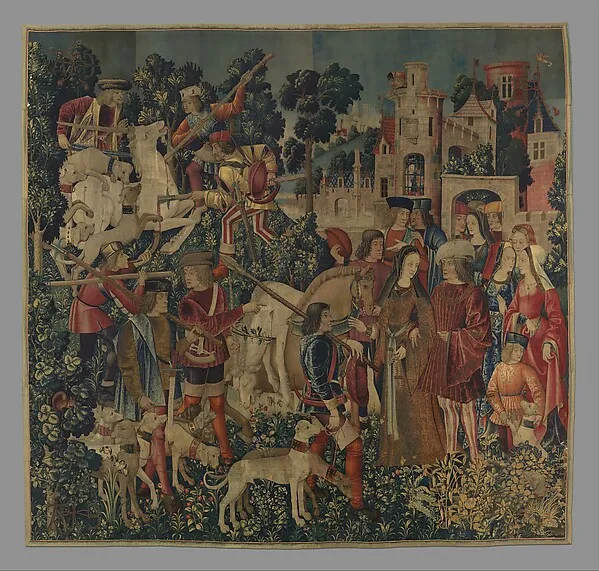
In the sixth, The Hunters Return to the Castle, they have it. At the left two hunters drive their lances into its neck and chest while a third finishes it from behind, and in the foreground its body lies slung across a horse, the horn already cut off, still tangled in thorny oak branches that the museum suggests may stand for the Crown of Thorns. The lord and lady of the castle come out to receive it.
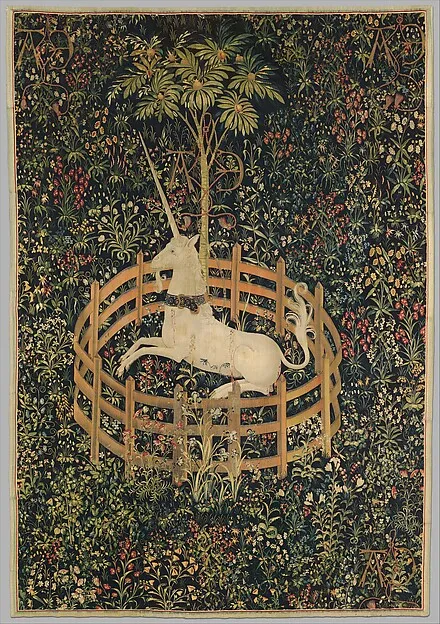
And then, unexpectedly, in the last and loveliest of them the unicorn is alive again, lying in a little round fence under a pomegranate tree in a field of flowers, chained to the trunk and collared. The red marks on its white flank are not blood, according to the Met’s own catalogue, but the juice of the bursting pomegranates above it. Margaret Freeman, who looked after the tapestries for the museum and wrote the standard book on them in 1976, read the panel as the end of the story: the beast “miraculously come to life again”, at once the risen Christ and a lover “at last secured by his adored lady”. It should also be said that the present curator thinks it may never have belonged to the series at all.
What the books said
The tapestries did not invent this animal. They inherited it from about two thousand years of people insisting, in writing, that it could not be had.
In the earliest descriptions, the unicorn does not resemble that which we are familiar with today.
Ctesias, a Greek physician at the Persian court around 400 BC, described it as a kind of wild ass from India with a horn a cubit and a half long, white, red and black, and said it was fierce and impossible to capture alive. The Physiologus, an early Christian book of beasts compiled in Greek in Alexandria and translated into Latin around the year 400, added the condition that every later account repeated: it allows itself to be taken only in the lap of a virgin. When it sees her it lays its head in her lap and falls asleep, and that is when the hunters come. The Christian reading was that the unicorn stood for Christ, who came willingly into the world through Mary.
The medieval bestiaries took it from there, and the University of Aberdeen has put its own fine bestiary online, page by page and with a translation, so that anybody may look. Its pages on the unicorn are lost, but its entry for the monoceros, the bestiary’s other one-horned beast, survives, and has no virgin in it and no mercy either. It is “a monster with a horrible bellow, the body of a horse, the feet of an elephant and a tail very like that of a deer”, with a horn four feet long, “so sharp that whatever it strikes is easily pierced”.
Ah, and there’s a sentence I should like carved over the door of every fantasy writer’s study: “No living monoceros has ever come into man’s hands, and while it can be killed, it cannot be captured.”
Perhaps this creature is a tidy analogy for perfection, then. Something that can be killed, but can never be had? It’s just a thought.
The horn
Naturally, the one thing everybody wanted was the one part of it that could be carried away. A unicorn’s horn or alicorn, as it was called, was held to cure a great many diseases and to reveal poison in a cup, and so cups were made of it for kings, and given to other kings, and kept in cabinets by people who had every reason to fear their dinners.
In 1638 a Danish physician, Ole Worm, showed that these horns were nothing of the kind. They were the tusks of narwhals, Arctic whales whose males grow a single spiral tooth through the upper lip. Twenty-four years later the Danish crown commissioned a coronation throne made of them all the same. Bendix Grodtschilling built it between 1662 and 1671, from Norwegian narwhal tusk, after the throne of Solomon, and set three life-size silver lions before it. Danish kings were anointed on it from 1671 until 1840, and it still stands at Rosenborg Castle in Copenhagen, where legend continues to describe it as unicorn horn.
I was raised to appraise fine things, and honestly, I am not certain whether to be appalled or impressed. If forgery is the word for a thing a royal house kept up in public for two hundred years, after one of its own subjects had shown what the horns really were, then it is the most distinguished forgery in Europe. We had a cabinet of curiosities at home in the long gallery on the third floor, and in it, a horn that my grandfather swore had come off a sea-unicorn taken by one of our captains in the cold seas. I loved it very much as a boy, though I now understand its rather gruesome providence. But I digress.
From the potatoes to the pony
The tapestries’ own history is a small comedy in itself. They belonged for centuries to the La Rochefoucauld family in France, were looted in the Revolution and were reportedly used to cover potatoes, which did them no good at all. I gather potatoes are kept under something, as a rule, and that a tapestry is not the usual choice. I have never had occasion to find out what is. Then, John D. Rockefeller Jr. bought them in 1922 and gave them to the museum in 1937, and they have been at the Cloisters since it opened.
Sadly, nobody knows who ordered them. The letters A and E are knotted into every one, and a theory that they were made for Anne of Brittany’s marriage to Louis XII of France, which held for more than thirty years, was put down by Freeman in 1976. The patron is gone, and so is the name of anyone who designed or wove them.
The animal, too, has since gone a long way from the woods. In the last forty years or so the unicorn has become a thing which appears on children’s plastic dinner plates and as fluffy toys, which is a perfectly agreeable fate for a make-believe horse. Ironically, what it has lost on the way is the one thing every source above agrees on, which is that you could not have one.
The verdict
There is a lesson here for anybody who writes the genre now. The unicorn held people’s imaginations for two thousand years for one reason, and the reason was the difficulty in obtaining one. It was rare; it came to the virgin and to nobody else; it could be killed but not kept; its horn was prized beyond all reason precisely because the rest of it was out of reach, and kings who could have anything else they liked sat on a throne of whale’s teeth to pretend otherwise.
In my opinion, every unicorn in a novel that can be saddled, petted or summoned has been given away cheaply, and to earn their original reputation and mystique back would not be too tall an order. A unicorn must simply resist being caught, fight back, and die if it fails. The weavers knew that in 1500, and now you do, too.