

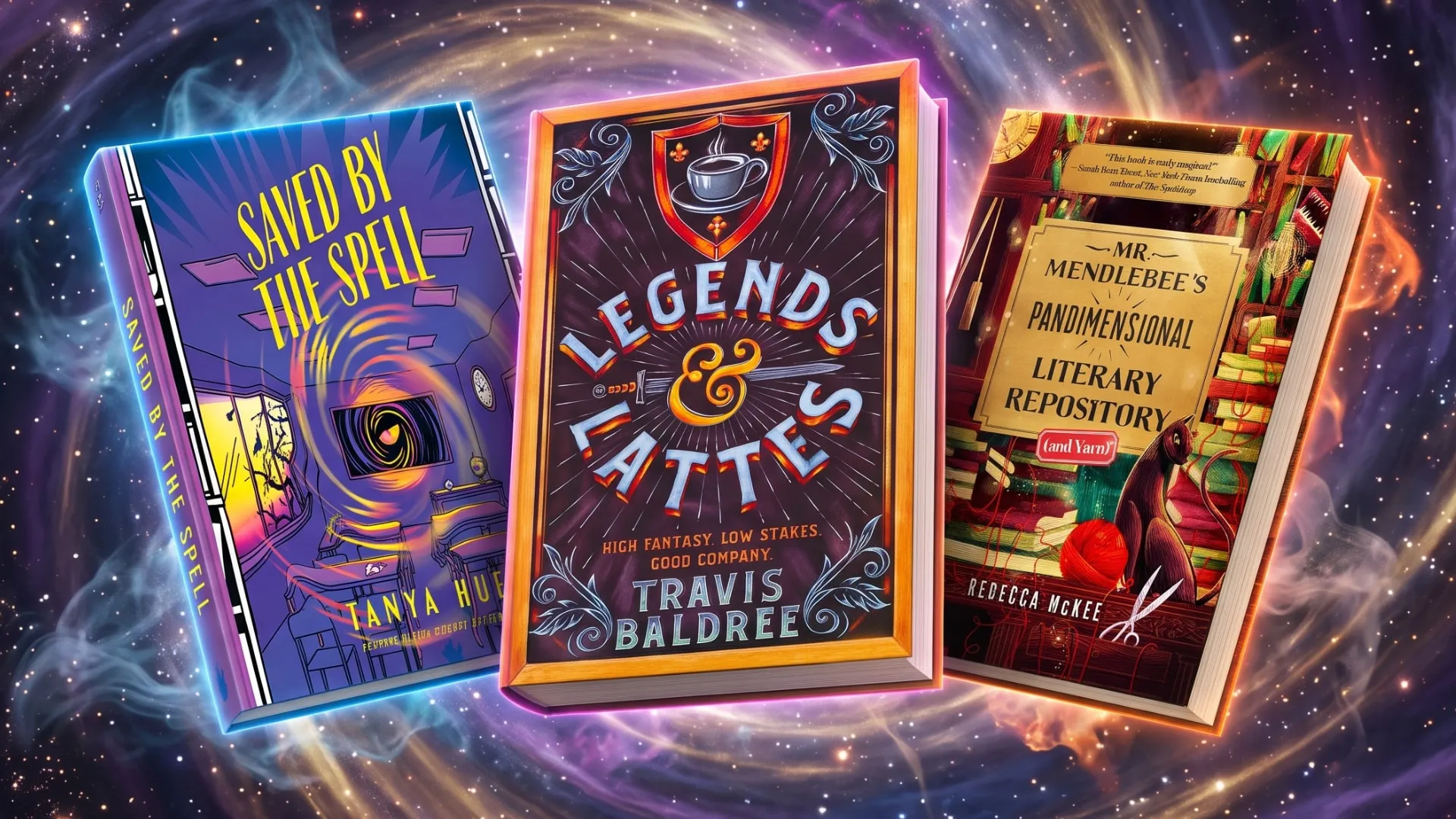
Nothing pleases me quite like a new find, and this month has brought me two from the same corner of the shelf. One is set in a shop and the other in a school, and both are about the people who work there and the business of keeping the doors open. That corner has been filling up since 2022, when an audiobook narrator called Travis Baldree put an orc behind the counter of a coffee shop.
Baldree wrote most of Legends & Lattes in twenty-six days. It was November 2021. He was taking part in National Novel Writing Month, the yearly challenge to draft a whole novel in thirty days, alongside a fellow audiobook narrator, Aven Shore-Kind. As it turns out, he did it with four days to spare.
Self-published the following February on Amazon under the imprint Cryptid Press, it sold well enough that Tor, one of the largest fantasy publishers in America, reissued it that November. It was a finalist for both the Hugo and the Nebula, the genre’s two best-known prizes for a novel, and it won the Locus Award for a first novel. That is a fine harvest from a book written in less than a month by a man who reads other people’s books aloud for a living.
A shop is a roof, a payroll and a till
Legends & Lattes is the story of an orc. Viv has spent her life as a mercenary, and in her forties she leaves her band, carrying a curious stone she took from a monster called a Scalvert Queen. She buys a derelict livery stable in a town called Thune and opens a coffee shop. Nobody in Thune has ever heard of coffee. Baldree, describing the book to Spokane Public Radio in 2024, admitted that this “sounds ridiculous, but it’s played totally straight.”
He is right on both counts. And the formula also seems to have been a winning one.
Almost everything that goes wrong in Legends & Lattes is a business problem. The stable needs rebuilding, so Viv needs a carpenter, and she finds one in Cal, a hob. The counter needs staff, so she takes on Tandri, a succubus. A ratkin baker called Thimble turns up and the shop starts selling his baking. The local protection racket, run by a figure called the Madrigal, expects to be paid. And Fennus, an old comrade from her fighting days, comes after the stone.
It all sounds much like any old Tuesday in any shop ever opened.
Those Tuesdays go back a very long way. Hammurabi, who ruled Babylon in the eighteenth century BC, had nearly three hundred laws carved on a stone pillar that now stands in the Louvre in Paris, and two of them are about women who kept taverns. One who shortchanged a customer paying in grain was to be thrown into the water. One who let conspirators meet under her roof without handing them over was to be put to death. By that measure Viv gets off lightly with a racketeer.
Baldree knows this from the inside. Before he narrated audiobooks he spent the best part of two decades making video games, and co-founded two studios, Runic Games, which made Torchlight in 2009, and Double Damage Games. He says his job there was engineering and running the companies rather than telling the stories. “I was an engineer, and I ran several companies,” he told Spokane Public Radio, and it shows in the troubles he chose for Viv.
He has a gentler way of putting what the book is for. “None of us are going to go slay a dragon,” he said in the same interview. “None of us are going to overthrow an evil overlord. But we might move to a new town, and we might have a tough time finding our people.” His summary is better than anything I could write: “The real escapist fantasy of legends and lattes is finding friends in your 40s.”
A comforting and realistic analysis, and I would only add that Viv finds every one of her friends by hiring them. Her found family is on the payroll, and that is not a cynical reading: it is how most people of forty do make new friends: at work, over a job that needs doing, with somebody who turns up on time.
This month’s shops
Our second find is Rebecca McKee’s debut, Mr. Mendlebee’s Pandimensional Literary Repository (and Yarn), out from Putnam on 17 November. Here, the shop sits by the sea “at the center of the universe” and holds lost things, forgotten objects and dangerous items best left unseen. It is staffed by a yeti-like Book Keeper, a wizened Yarn Weaver, a clerk who is a fish out of water and a cat called Muriel. It keeps the universe running, it opens its doors only to the people who need it most, and it warns them: “Once you’ve visited, you may never return.”
McKee studied at the University of Iowa, and her writing has won the Iowa Chapbook Prize. By day she is an assistant director of career services at a private university. Her working week is spent matching students with the jobs they need, so I was delighted to find that she has invented a shop that does much the same work: it lets in only the people who need it most, though only once.
Then the shop breaks its own rule. Violet, who lives in the repository and is a friend of Mr. Mendlebee’s, starts seeing ghosts, a knock begins to sound from nowhere, and the shop lets in its first repeat customer, a young woman called Rachel, who may hold the key to whatever has gone wrong at its heart.
Putnam compares the book to Matt Haig’s The Midnight Library, a novel about a library of the lives a woman might have led, and to Alix E. Harrow’s The Ten Thousand Doors of January, a novel about doors into other worlds. Both comparisons suit a shop with a yarn counter and a cat. But a shop that keeps the universe running has a very large job, so the question I will bring to it is whether it is still a shop by the last chapter, or a cosmos with a counter? Perhaps that’s immaterial.
Our last book comes from a writer who has stood behind a real counter. Tanya Huff is a Canadian fantasist with more than thirty novels to her name, among them the Blood Books, about a detective who becomes entangled with a vampire, which became the television series Blood Ties. From 1984 to 1992 she worked at Bakka, a science fiction bookshop in Toronto, and wrote seven novels in those eight years.
Her new one, Saved by the Spell, published by DAW on 3 November, moves the business from a shop to a school. It is September at the High School for Magical Arts, and the teachers are hoping for a quiet year. By the end of fourth period on the first day, a student called Bex Olynyk has stood up to a bully, turned out to be more powerful than anybody expected and acquired a loyal roommate, and the staff can see what is coming: “Where there’s a Hero, there’s bound to be a Villain.” Overworked and underpaid, they now have to keep the Hero alive, keep the damage down, find the student who will turn villain and keep “math scores up to the national level”.
The maths scores are my favourite detail on the jacket. When I represented Port Kithiria, the harbour accounts came due in the same week the Tyrant Empress closed the strait to our shipping. Nobody in the treasury mentioned the strait. They wanted the accounts by Thursday, and they had them on Thursday.
DAW sells the book as “Abbott Elementary, but make it magical”, after the American sitcom about teachers at an underfunded school in Philadelphia, and calls it a romp through fantasy school tropes “from the other side of the desk.” A school story told from the staff room is a story about work, and it is the most promising premise I have met this year.
The ledger test
What makes a book like these cosy? Not the tea. Baldree’s own name for them, “chicken soup fantasy books”, describes how they feel to read rather than how they are built.
What Baldree built was a premises, a staff, a rival, a racket and a product that customers had to be talked into trying. His prequel, Bookshops & Bonedust, sent a younger Viv to work in a bookshop in 2023 and kept to the same plan. The comfort comes out of that work, the way warmth comes out of a stove somebody has to keep fed. Take the work away and you are left with a nice room with nothing happening in it. Raise the stakes to the end of the world and you have a different kind of book altogether: an epic fantasy with a café attached.
The latter two books flirt with that second danger. Huff’s teachers have a Hero and a Villain on the register, and McKee’s shop has the universe resting on it. Each brings the big story into the small place, and each will stand or fall on whether the small place keeps its shape.
I take heart from these writers. All three know the work from the inside: Baldree ran companies, McKee finds students their jobs, and Huff spent eight years behind the counter at Bakka. People who have done the job tend to remember the details which adds a touch of realism otherwise difficult to glean.
In other words, these fantasies depict businesses as they could actually be run. Legends & Lattes passed that test four years ago with a roof, a payroll and a racketeer. Mr. Mendlebee’s repository and the High School for Magical Arts will have to show me their ledgers. If a fantasy book stands or fails on the believability of its premise and mechanics, these will do very nicely.