
The children who queued for the first Harry Potter film in November 2001 are in their thirties now, and a good many of them will still sit down on Christmas Day to watch the story begin again. This time, a good many of them will also sit with children of their own beside them, some of whom may be eleven, which is exactly how old Harry is when the letters start arriving.
Perhaps you, dear reader, need no refresher. But for anyone who wasn’t alive during the Pottermania of the nineties and naughties and who has somehow avoided the Wizarding World, Harry Potter and the Philosopher’s Stone was J. K. Rowling’s first novel, published in 1997 (and in America the following year as Harry Potter and the Sorcerer’s Stone), and is the story of an orphan raised in a cupboard under the stairs by an aunt and uncle who resent him, and who learns on his eleventh birthday that he is a wizard and that a school called Hogwarts has been expecting him for years.
Chris Columbus, the American director of Home Alone and Mrs. Doubtfire, made it into a film that had its premiere at the Odeon in Leicester Square on 4 November 2001 and opened in Britain and the United States on the 16th. It ran for 152 minutes and took $974 million in its first release.
Now, almost thirty years later, HBO’s television series of the same book is about to begin. On 25 December, on HBO and HBO Max, in eight episodes, Harry Potter and the Philosopher’s Stone will be retold. It is a remarkable and ambitious thing to attempt to remake a story that has already been filmed once, and faithfully, by most accounts, with the author’s blessing, and which has become a classic of the genre.
Still, there was a problem with the film, and the only argument for doing it again that I find persuasive is that this time, nothing needs to be left out.
The first time
Rowling had far more say in 2001 than most novelists are ever given. When she sold Warner Bros. the film rights to the first four books in 1999, for a reported £1 million, she had hesitated for a long time, because she “didn’t want to give them control over the rest of the story”: a studio that owned her characters could have made sequels she never wrote. She insisted that the cast be entirely British and Irish. Steve Kloves, the screenwriter, added dialogue of his own, which she approved, though she had one line removed because it would have contradicted something in the fifth book, Harry Potter and the Order of the Phoenix, which nobody else had yet read.
Steven Spielberg had talked about directing it and moved on. Rowling’s own first choice was Terry Gilliam. Warner Bros. chose Columbus, for his films about families, and he made exactly the film that brief suggests: warm, handsome, carefully cast, and loyal to the plot. Todd McCarthy, reviewing it for Variety, wrote that “the script is faithful, the actors are just right”. Richard Corliss of Time was less impressed and called it a “by the numbers adaptation”, which was meant as a complaint and reads now as a fair description of its virtue.
Of course, what it could not do was fit a novel of that size into two and a half hours.
What two and a half hours could not hold
The book opens with a chapter told from the side of Uncle Vernon, who runs a firm that makes drills and wants nothing to do with anything unusual, on a day when owls fly about in broad daylight and strangers in cloaks gather on the streets. The film begins elsewhere. Likewise, in the book Harry first meets Draco Malfoy, the sneering boy who becomes his rival, in a robe shop in Diagon Alley; the film moves the meeting to the school. In the book Draco challenges Harry to a wizards’ duel at midnight and then tips off the caretaker, which is how Harry, Ron, Hermione and Neville stumble on the three-headed dog guarding the third-floor corridor; the film finds another way there, and the duel is gone.
Also missing was Peeves the poltergeist, who haunts Hogwarts dropping things on people’s heads, even though the comedian Rik Mayall was cast and filmed his scenes, as is one of the trials around the Philosopher’s Stone at the end: a riddle of seven bottles set by Professor Snape, which Hermione solves with logic while Harry watches, impressed.
Columbus has said, with some regret, that he minded both losses. “I missed the fact that I was never able to put Peeves in the first film,” he told the Radio Times. Of the potions riddle he said: “It’s like this incredible chess match that we just did not have time to shoot.” I like him for saying it. Nothing he cut was cut out of disrespect for the book; it was cut because a cinema audience can only sit still for so long, and a film that tried to keep everything would have been a worse film.
The second time
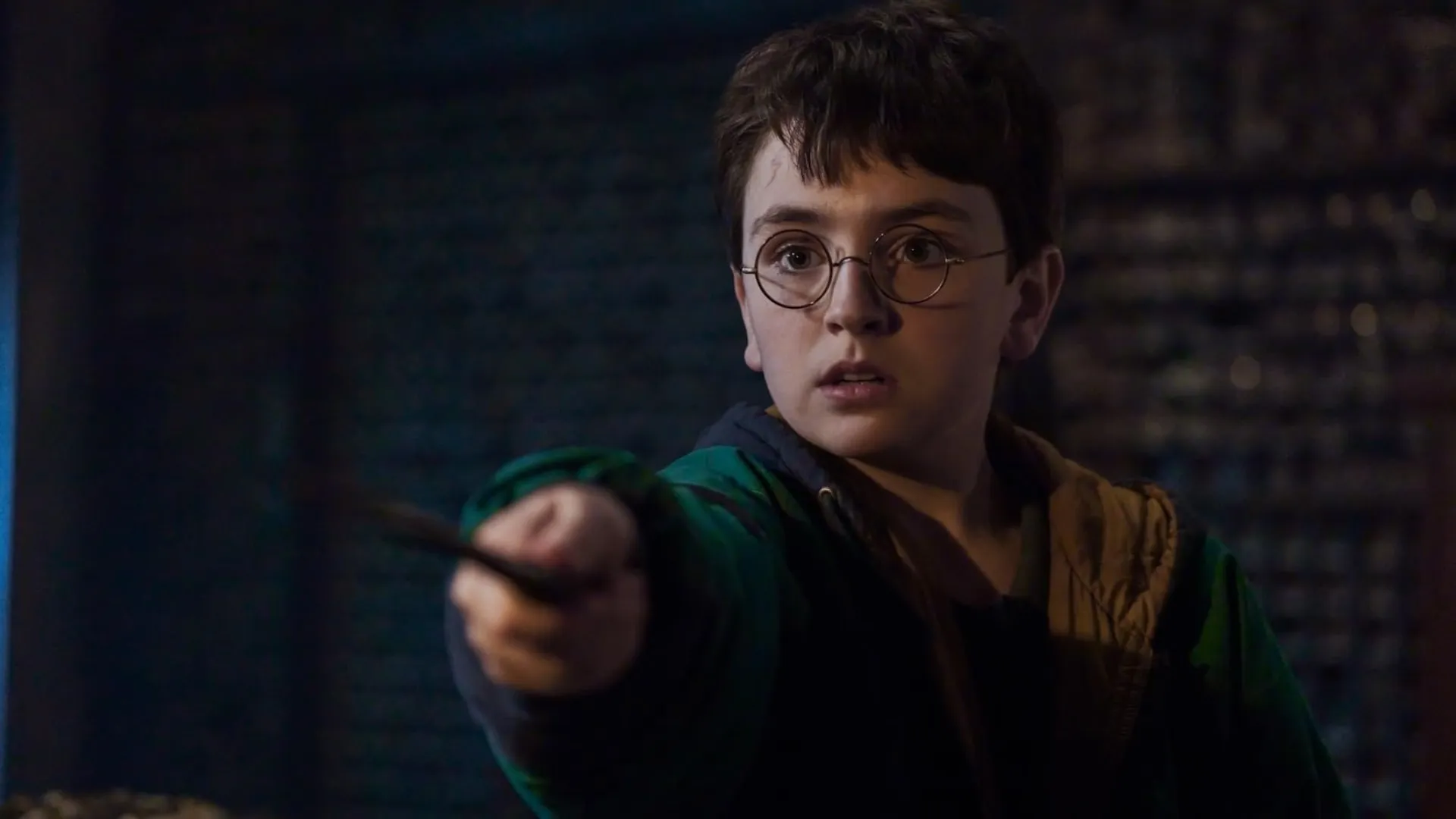
The series has been in the making since Warner Bros. announced it in 2023. Its showrunner is Francesca Gardiner, a writer on Succession, with Jon Brown alongside her since May, and Mark Mylod, who directed some of the finest episodes of Succession, directs the first. Dominic McLaughlin plays Harry, Arabella Stanton plays Hermione and Alastair Stout plays Ron, with John Lithgow as Dumbledore, Janet McTeer as McGonagall, Paapa Essiedu as Snape and Nick Frost as Hagrid. The plan is a book a season, and HBO renewed it for a second, Chamber of Secrets, before the first had aired.
Rowling is an executive producer. She has no writing credit, but she said last year that she had “worked closely” with the writers and praised the scripts of the first two episodes. Casey Bloys, who runs HBO, has said that she “was very involved in the process of selecting the writer and the director”.
When the series was announced, Rowling explained why she had agreed to it: “Max’s commitment to preserving the integrity of my books is important to me,” she said, and the new adaptation “will allow for a degree of depth and detail only afforded by a long form television series.” HBO’s own page for the teaser promises “a faithful adaptation of the books”.
The only argument for doing it that I find persuasive is that this time nothing needs to be left out.
The case for making it
That sentence of Rowling’s is the whole case. An author’s stated intention is evidence, and here it is unusually plain: she wanted a version with enough room to tell it properly. Columbus has already given us the faithful film. If the series is to justify itself, it has to be the faithful book.
That sets a clear standard. Everything the film had to lose for time should come back: the Dursley chapter, the robe shop, the duel, Peeves, the bottles. Anything else the series changes ought to answer to the book, because the main advantage HBO has over Columbus is more space.
There is reason to be hopeful. The teaser HBO released in March shows Dudley Dursley and his gang tormenting Harry at his ordinary school, a scene from the book that never reached the cinema, and two more straight from the novel’s opening chapters: Aunt Petunia cutting his hair with the kitchen scissors, and Harry and Hagrid riding the London Underground. And in June Variety reported that Peter Serafinowicz had been cast as Peeves, which is a very exciting point that hasn’t been widely reported on. A poltergeist is not essential to the plot, which is exactly why he was cut in 2001 and exactly why his return suggests that the people making this have understood what they are for.
What HBO has said beyond that is not much more than the word “faithful”, and a word is not a season; Christmas Day will tell us the rest.
The dream of it
Every reader of the book carries a version of it that no adaptation could match, and the danger for those of us waiting is that we judge the series against that instead of against the novel. In fact, as I write this, the words of Mr. Ollivander are echoing like the jangling of a Hogwarts ghost in my head, repeating the famous line, “I think we must expect great things from you, Mr. Potter…” and I believe many viewers will be hearing them, as well.
I have my own reasons to care about returning to a story one thought was finished, and I know how rarely anyone is given a second go at it with more time than the first. Rowling has been given one, and Columbus has been generous enough to say what he wished he had kept. If HBO uses its eight episodes to keep it, the children who queued in 2001 will find, at Christmas, that the door they went through is still there and that it opens a little wider than they remembered.