



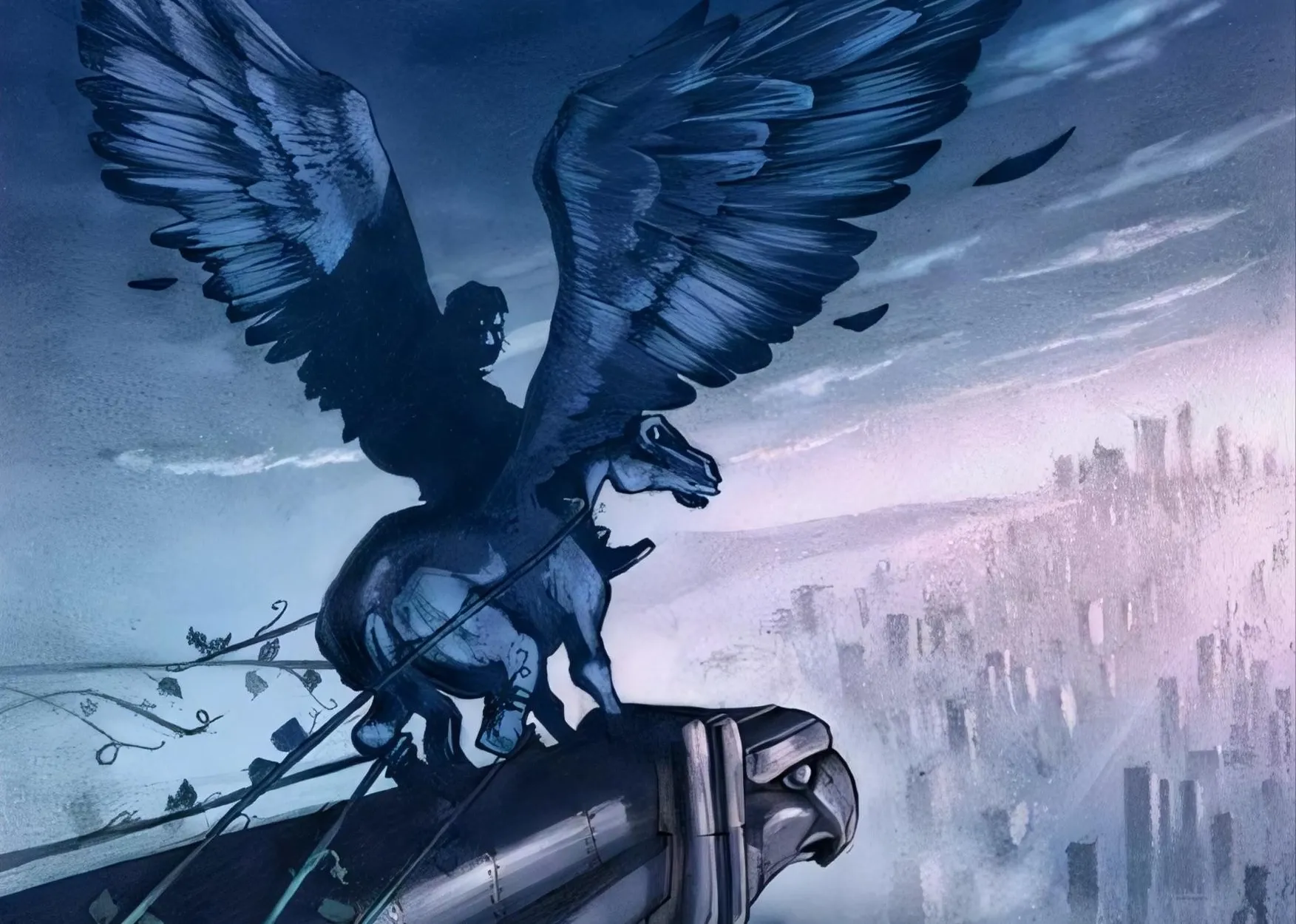
In January 2009, a year before the first Percy Jackson film reached cinemas, Rick Riordan wrote to its producers to tell them they were about to make a mistake. He had heard that the studio meant to make its heroes seventeen.
“The series is grounded on the premise that Percy must progress from age twelve to age sixteen,” he wrote, “when according to a prophecy he must make a decision that saves or destroys the world.” Start the boy at seventeen, he warned, and there is nowhere left for him to grow, and no way to film the books that follow.
Riordan is the American author of the five Percy Jackson and the Olympians novels, which began with The Lightning Thief in 2005 and follow a boy from New York who discovers that his father is Poseidon, the Greek god of the sea, and that the gods of Olympus are alive, unruly and living above the Empire State Building. They are books for readers of nine to twelve, and they have been read by a great many of them, and by a fair number of their parents.
As is often the case with adaptations in recent years, the studio didn’t take the author’s comments seriously and made the heroes older anyway.
The Disney+ television series has been a different arrangement from its first day. Riordan created it with the television writer Jonathan E. Steinberg and is an executive producer alongside his wife, Becky; he co-wrote three of the first season’s eight episodes, including the first two, and the opening episode of the second. Both seasons were made with his direct involvement, and the reviews have tended to say so: Rotten Tomatoes, which collects critics’ verdicts, sums up the first as “a faithful adaptation of Rick Riordan’s novels”, and the second has a score of 100 per cent.
It’s now 2026, and on 20 November the series begins its third season, which adapts The Titan’s Curse, the third book, the one the films never reached. This season’s scripts are credited to the show’s other writers rather than to Riordan, but he remains its co-creator and an executive producer, and he is not writing letters to anybody this time, because he is one of the people they would be addressed to.
What the films did
Percy Jackson & the Olympians: The Lightning Thief, directed by Chris Columbus, opened in February 2010 on a budget of $95 million and took about $226 million worldwide. Sea of Monsters followed in August 2013, cost $90 million and took about $202 million. A third film was planned and never made.
Those are not disastrous numbers, but they are not the numbers of a franchise either, and the reason is the one Riordan had set out in his letter. In March 2009 he read the script and wrote again. He found things to like in its opening scenes, and then he was plain: “The script as a whole is terrible.” It was not only that it departed from the book “to point of being almost unrecognizable as the same story”, he wrote, but that “even if you pretend the book doesn’t exist, this script doesn’t work as a story in its own right.” He had noticed something that studios are still slow to learn: “I see a direct correlation between how faithful an adaptation is and how well it does at the box office.”
He published both letters on his website in November 2018, explaining that the rights had been “signed away before the first PJO book was even published”, and that under a contract like most authors’, “Hollywood controls all things and all decisions about the movie.” He never watched either film. He invited his readers to look at his website and see whether there was any sign there that the films had ever existed. “No,” he wrote. “No, you do not.”
In June 2020 a reader asked him on Twitter about a scene in the first film, and he answered more sharply than I think he usually allows himself. “To me, it’s my life’s work going through a meat grinder when I pleaded with them not to do it.”
The second chance
Most authors do not get one. Riordan’s came through a merger: when Disney bought 20th Century Fox in 2019, the rights to his books came with it. He has said he was in no hurry. “After the movie experience, I basically wrote off Hollywood for a long, long time,” he told Variety in 2023.
What changed his mind, after a good many meetings, was that this time he would be inside the room. He argued for television rather than film, because it was “the better format for Percy, because it allows us a larger canvas to tell more of the story”, and because it could be “more faithful to the source material, which is what the fans of the books really would love to see.”
The first season, adapting The Lightning Thief, began in December 2023 and drew 26.2 million viewers in its first three weeks. The second, The Sea of Monsters, followed in December 2025, and Nielsen counted it the most-watched Disney+ original series in America that season, which is a measure against the rest of Disney+ rather than against the first season: as the figures further down show, its own audience had shrunk considerably. The show has not been a page-by-page transcription, and it was never going to be, but whatever it has changed, it has changed with the author’s agreement, which is the only kind of change the books’ readers have ever really been willing to forgive.
That matters more to this paper than it might to some. We have already argued about other adaptations that when an author’s intentions are on the record, they should outrank a director’s. Usually, the split happens because those two roles are working in separate worlds. Here they are working together.
Riordan is not writing letters to anybody this time, because he is one of the people they would be addressed to.
The book the films never reached
The Titan’s Curse was published in May 2007, and it is the book in which the series changes key. Percy is fourteen. He and his friends go to rescue two children, a brother and sister called Nico and Bianca di Angelo, from a boarding school, and they come back without one of their own. Artemis, the goddess of the hunt, and her company of immortal Hunters come into the story, and so does Atlas, the Titan condemned to hold up the sky. By the end, the war the first two books warned of is plainly coming, and the prophecy Riordan described in his letter is no longer a distant thing.
It is also funnier than that makes it sound, as all of them are, and quicker. But it is the first of the books in which something is lost that is not got back, and readers who were ten when they found it remember where they were when they reached the end.
The season has been cast with care. Holt McCallany plays Atlas, Dafne Keen plays Artemis, Saara Chaudry plays Zoë Nightshade, the lieutenant of the Hunters, and Levi Chrisopulos and Olive Abercrombie play Nico and Bianca. The trailer, first shown at Disney’s D23 convention in August, reduces the season to five words: “Find Annabeth. Stop the Titans.” Eight episodes begin with two on 20 November and continue in pairs until 11 December.
What the readers are waiting for
Of the five books, The Titan’s Curse is the one its readers have waited longest to see, and not only because the films stopped short of it. It brings in the Hunters of Artemis and Nico di Angelo, two of the things the fandom most wants to see done well, and it is where the larger war takes hold. Walker Scobell, who plays Percy, put it the way a reader would: it is the book where the series “really hooks into the meat of the story”. He told Entertainment Weekly in July that this is “definitely our darkest season yet”, and at San Diego Comic-Con the same month he said he thought it the most faithful to its book of the three.
The anticipation is not unmixed, and the reason is the end of the second season. In the books, Thalia Grace, a daughter of Zeus, makes a stand against pursuing monsters at the border of Camp Half-Blood so that her friends can reach safety, and her father turns her into a pine tree to save her life; at the close of The Sea of Monsters she is brought back. The show kept the return but reversed the story behind it. In its finale Chiron, the centaur who teaches at the camp, admits that Zeus transformed her in anger because she had refused to become his weapon, and then ordered Chiron to tell everyone she had given her life willingly.
Some readers took it badly. One, quoted by the Disney fan site Inside the Magic, called it a “catastrophic misstep” that “fundamentally undermines her character arc and the core moral dilemma of the entire Percy Jackson series”; others pointed out that if Chiron has been lying all along, Luke Castellan, the son of Hermes who has gone over to the Titans, is suddenly the one character telling Percy the truth. Craig Silverstein, an executive producer and one of the show’s writers, calls it “a binary flip on what was told”, a rescue that “was really a punishment”, and says it turns what the books only talk about “into something that’s real”. Riordan, speaking to the Radio Times in January, said “we were fairly confident that most of the tweaks that we had done would be well received”. The pronoun is the point: these are the author’s changes too, which is why the dispute over Thalia has stayed a disagreement among people who love the books rather than the grievance the films left behind. The third season will show whether a Zeus who punishes his daughter and a Chiron who lies about it can be carried through a book that was written without either.
The audience waiting is also smaller than it was. Luminate, which measures streaming in America, estimated 31.5 million views of the first season in its first three weeks and 11.2 million of the second over the same span, and suggested that the two-year wait between them had let some of the show’s young viewers grow out of it. A season adapting the book its readers love best is the obvious way to bring them back, and it is also the one in which the show’s own inventions will be tested hardest.
The clock
There is one thing even an author cannot keep, and it is the thing he wrote to the studio about in 2009.
Walker Scobell, who plays Percy, was born in January 2009, the month that letter was sent. He was thirteen when he was cast and fourteen when the first season arrived. He is seventeen now, playing a boy of fourteen, and so by the calendar rather than by anyone’s decision, Percy has reached the age the studio once wanted him to start at.
Nobody has done anything wrong. Television takes the time it takes, and the gap between seasons has been shortened rather than allowed to drift: two years between the first and the second, eleven months between the second and the third. But a story about growing up runs at one book a year, and a camera cannot quite keep pace with a child, and I have some sympathy for anyone caught on the wrong side of that arithmetic. I have spent long enough trying to get back to a place I left to know that the years do not wait for you while you find the way.
It is worth remembering, though, what Riordan’s letter was really about. It was not that a boy on screen must be exactly twelve. It was that the story needs room to grow up in, and a hero who has somewhere left to go. The films never got there. On 20 November, with its author on-hand, the series will, and for the first time a reader who loved this book as a child has every reason to hope that what they see will be the story they remember.