
In the Russian tales, Baba Yaga’s teeth are less a description than part of her name: she is Baba Yaga with iron teeth, or Baba Yaga the bony-legged, in the way that a king might be called the Bold.
Here is a witch of the Russian and wider Slavic folk tale, an old woman who lives alone in a hut in the forest, and she is old even by the standards of witches. She was first clearly written down in 1755, when Mikhail Lomonosov, the Russian scientist and poet, put “Iaga baba” into his Russian Grammar. He was setting the old Slavic gods beside their Roman equivalents, and when he came to her he could not find one. She had to go in a section of her own.
She is about to be busy again. On 3 November Orbit publishes The Wolves of War, the first book of the Wolfheart Chronicles by John Gwynne, the British author of The Faithful and the Fallen and the Bloodsworn Saga. The publisher says the book is inspired by Slavic mythology, and among its cast it lists “an iron-toothed witch who haunts the shadows”. It does not give her a name. Given, I have not read the book yet, but anybody who has read a Russian fairy tale will have guessed what that means.
The hut and the furniture
We should probably take a look at the house, because it’s not your regular pointy-roofed, candy encrusted witch’s cottage. Indeed, Baba Yaga’s hut stands on the legs of a hen.
The best account of it I know is in Old Peter’s Russian Tales, which Arthur Ransome, the English writer later loved for Swallows and Amazons, put together in Russia and published in 1916. In it, an old forester tells stories to his two grandchildren and the boy asks to hear about the hut again, though he has heard about it many times. “Sometimes it faces the forest,” says the grandfather, “sometimes it faces the path, and sometimes it walks solemnly about.” In other tales, he adds, the hut has a railing of tall sticks with a skull on each one, “and all night long fire glows in the skulls and fades as the dawn rises.”
The boy wants to know whether Baba Yaga really has iron teeth.
“Iron, like the poker and tongs,” says old Peter.
That made me chuckle because it seems so perfectly grandfather-esque an answer. But it is also a very useful description of a monster which conjures about as terrifying an image of someone’s teeth as one could want.
Next, there is her transport. Baba Yaga does not ride a broomstick. She sits in a mortar, the heavy bowl that grain is pounded in, drives it along with the pestle, and sweeps away her tracks behind her with a broom, so that nobody can tell which way she has gone. Andrey Toporkov, a Russian ethnographer, has suggested that the pestle came first, as a weapon, and that the mortar was added afterwards by association. I like that very much. She began with a club and acquired a vehicle because the club came with it.
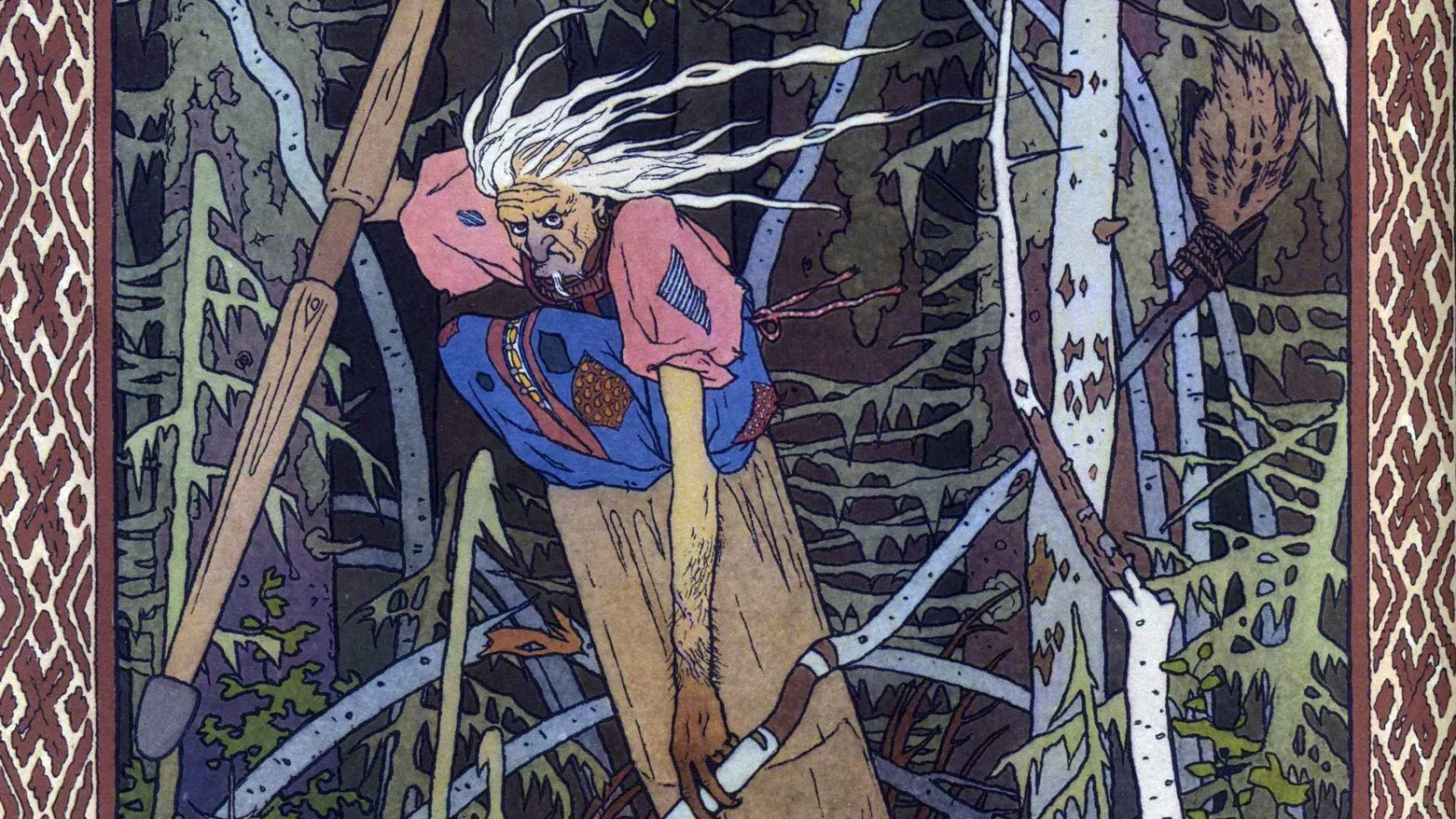
When Ivan Bilibin, the Russian illustrator, painted her in 1900 for an edition of the tale of Vasilisa the Beautiful (his picture is at the top of this page), he was careful with the details. Baba Yaga is poling through a birch wood with the pestle as though it were a punt pole. The broom is tucked behind her like a rudder. And at the foot of the picture, which this page has had to crop, Bilibin has scattered red toadstools with white spots and the fly agaric, which is poisonous. Nobody in the tale mentions them. He put them in anyway, as a nod to the character’s danger and peril.
Which way she turns
Now, the important thing about Baba Yaga, and the reason she has outlasted almost every other monster in the cupboard.
You cannot tell in advance what she will do.
In the tale of Vasilisa the Beautiful, collected by Alexander Afanasyev, who took down Russian folk tales in the 1850s and 1860s, a girl has a cruel stepmother and a small doll that her dying mother gave her, which comes alive when it is fed and does her chores while she sleeps. The stepmother has moved the family to the edge of a forest in the hope that the girl will meet the witch there, and one autumn night she has every light in the house put out, so that Vasilisa must go to Baba Yaga’s hut to beg for fire and, the stepmother hopes, be eaten.
In the forest a rider in white gallops past her and the dawn comes, then a rider in red, and the sun rises. At nightfall she reaches the hut, whose fence is built of human bones and topped with skulls, just as a rider in black vanishes through the gate and the eyes of every skull light up. Baba Yaga appears, and says she will give the girl fire if she works for it, and eat her if she does not. Her tasks take place over a couple of nights, and involve picking a measure of wheat clean of black grains, then extracting poppy seeds from earth, each of which the doll does overnight. Each evening the witch inspects the work, finds nothing to complain of and is furious about it.
On the third evening Vasilisa asks about the riders, and the witch explains that they are her Day, her Sun and her Night. Vasilisa asks no more, as the witch earlier warned that not every question leads to good, and it is as well that she recalls this for the three pairs of disembodied hands that serve the witch, Baba Yaga tells her, would have seized her too. Then she asks how the girl managed the work, and Vasilisa says it was her mother’s blessing, at which the witch throws her out, because she wants nothing to do with the blessed. But she gives her the light she came for, a skull with burning eyes.
Vasilisa carries it home to a house where no fire would stay lit since she left, and for the first time in her life she is welcomed at the door. The skull is set on a candlestick in the best room, and its eyes follow the stepmother and her two daughters wherever they run, until all three burn to ashes.
What we have, therefore, is a tale where the witch threatens to eat the girl and then hands her the very thing that saves her, which squares with Ransome’s grandfather’s explanation that “Baba Yaga is a witch,” and, “a terrible old woman she is, but sometimes kind enough.”
The scholars agree that this is the whole point of her. Andreas Johns, a folklorist who has written a book-length study of her, Baba Yaga: The Ambiguous Mother and Witch of the Russian Folktale, describes her “striking ambiguity”. Vladimir Propp, the great Russian folklorist who spent his career taking the wonder tale apart to see how it worked, found that her appearances “do not create a coherent image”.
All of that may sound like a complaint, but for a storyteller it is a gift.
The choice
What decides which Baba Yaga you get? The tales have an answer, which will not surprise any familiar with the moral quandries presented by the Brothers Grimm.
Ransome tells a story of a little girl with a kind heart, who is sent to the witch by her stepmother to borrow a needle and thread. On the way she picks up whatever she finds, and at the hut she gives it all away. She oils the gates, which squeak miserably. She gives the starving dog a loaf, the thin black cat some scraps of meat, the crying servant a handkerchief, and she ties back a birch tree with a ribbon. Then Baba Yaga sets her to weave and goes off to heat the bath, meaning to eat her.
The cat takes her place at the loom, and the girl runs. The gates let her through without a sound. The dog lies down again. When the witch finds the girl gone, she storms round the yard demanding to know why nobody stopped her, and one by one her household answers.
“In all the years I have served you,” says the cat, “you have only given me one little bone; but the kind little girl gave me scraps of meat.”
“In all the years I’ve served you,” says the dog, “you never threw me anything but burnt crusts; but the kind little girl gave me a good loaf.”
The gates say the same, and so do the birch tree and the servant. I kept accounts for a living for many years, and I have never seen a clearer audit. Baba Yaga does not lose the girl to magic. She loses her because she ran her household on burnt crusts and never once oiled a hinge, and her staff took the first better offer that came through the gate.
That is why she is so useful. She is not really a villain or a helper. She is a test, and the hero determines if they pass or fail. The girl who is courteous, who works, who is kind to animals and servants and gates, gets out alive, often with something valuable. The one who is rude or idle or too curious does not. Baba Yaga is the forest’s judgement on how you behaved on the way to her door.
What Gwynne has to keep
Of course, none of this tells us what John Gwynne has done with her, and I will not pretend it does. The Wolves of War arrives on 3 November, and the iron teeth in the publisher’s copy are the only clue anybody has that this fascinating piece of Russian folklore is in the cast.
We do know what to look for, however. A witch with iron teeth who only ever bites is a perfectly good villain, and there are plenty of them. Baba Yaga is something rarer, a monster you can win over if you have earned it, and who will eat you if you have not. A novelist who borrows her inherits that uncertainty, and an excellent narrative device that should keep the reader on their toes.