



Every year the people who live in the mud huts under the walls of Gormenghast carve figures out of wood and paint them in strange colours. On the first morning of June the Earl of Groan judges them on a white stone shelf at the foot of the outer wall. No more than three are kept. The rest are burned that same evening in the courtyard below his balcony, while the Earl stands above and bows his head as if in pain.
That is on the first pages of Titus Groan, and it tells you most of what you need to know about the place. Gormenghast is a castle that runs on ritual. Nobody inside it remembers what the rituals are for. They are done anyway, every day, exactly, because they were done yesterday.
Mervyn Peake published the novel in 1946. He was a painter and an illustrator before he was a novelist, and the book reads like it. I mean that as the highest praise I have, and also as a warning.
The painter
Peake was born in 1911 in Kuling, in China, where his father was a missionary doctor. He trained at the Royal Academy Schools in London and spent some of his twenties on Sark, one of the Channel Islands, painting. Through the 1940s he illustrated other people’s books: Lewis Carroll’s The Hunting of the Snark in 1941, then Coleridge’s The Rime of the Ancient Mariner, the Grimms’ Household Tales, Alice, Dr Jekyll and Mr Hyde and Treasure Island. He began Titus Groan while serving in the army during the Second World War. Eyre & Spottiswoode brought it out in 1946.
In 2010 the British Library bought his papers. They include thirty-nine handwritten notebooks for the Gormenghast books, full of character sketches, ink drawings, watercolours and decorated borders around the text. When the library later acquired his drawings as well, the announcement spoke of “his synesthetic creative process whereby he drew pictures to stimulate his writing.”
That one line explains the whole book. Often Peake drew a person first and then wrote down what he had drawn.
What it looks like
The story is simple to state. An heir is born to Sepulchrave, the melancholy seventy-sixth Earl of Groan, and the castle has to absorb the event. Around the cradle stand the people who keep Gormenghast going. Flay is the Earl’s bony and loyal servant. Swelter is the vast chef who rules the kitchens and loathes Flay. Doctor Prunesquallor, the castle physician, laughs at his own jokes. The Countess Gertrude keeps birds and white cats and has little time for anything else. Her daughter Fuchsia is fifteen and fierce. Nannie Slagg is the old nurse. And Steerpike is a kitchen boy who wants very much to be somewhere higher than the kitchen. I will say no more about any of them than that. The pleasure is in meeting them.
And you do meet them. You see them. Here is Rottcodd, the curator who sleeps in a hammock in the Hall of the Bright Carvings because nobody ever visits it:
“His skull was dark and small like a corroded musket bullet and his eyes behind the gleaming of his glasses were the twin miniatures of his head.”
Here is Flay, a few pages later, whose face is all crags and angles:
“His eyes were almost transparent as though in a country of ugly hills one were to find among the harsh rocks two sky-reflecting lakes.”
And here is the doctor, mid-performance, with “his magnified eyes skidding to and fro behind the lenses of his glasses, like soap at the bottom of a bath.”
You may notice that each of these quotes describes eyes, and not one of them described the way you would expect. A musket ball. Two lakes. Soap in a bath. Each of those is a thing you have held or seen, and each one puts the face in front of you at once. That is a painter’s habit. He does not tell you a man is sly or gentle. He shows you the shape and lets the shape do the work.
The rooms get the same care. In the Countess’s bedroom, “like a vast spider suspended by a metal chord, a candelabrum presided over the room.” The Hall of the Bright Carvings is lit night and day by seven great candelabra hung nine feet apart, and the candles are never allowed to gutter. I have stayed in some cold inns. I have never wanted so badly to know who pays for the candles.
Even exiting a room gets painted. Where another writer would say that somebody hurried out, Peake has a character leave “in a typhoon of silk”. Five words, in which you can hear the fabric.
A musket ball. Two lakes. Soap in a bath. Each one puts the face in front of you at once.
This book is also very funny, which nobody warned me about. Peake can manage a great deal in a single line, including this one about the manservant, Flay: “He saw in happiness the seeds of independence, and in independence the seeds of revolt.” I laughed at that in a coffee house and an old woman moved seats. The doctor is funnier still, and when he gets going, holding forth to anyone who will stay in the room, the book becomes a comic novel for pages at a time. I’m a firm believer that extracting emotion like this from a reader is a difficult. Peake achieves it with apparent ease, and very often.
The weight
Now the warning. Here is the first sentence of the book:
“Gormenghast, that is, the main massing of the original stone, taken by itself would have displayed a certain ponderous architectural quality were it possible to have ignored the circumfusion of those mean dwellings that swarmed like an epidemic around its outer walls.”
It is a fine sentence. It is also forty-two words long, it stops to say “that is” before it has properly started, and it uses “circumfusion”, which means pouring something around something else. I looked it up. Most readers probably won’t.
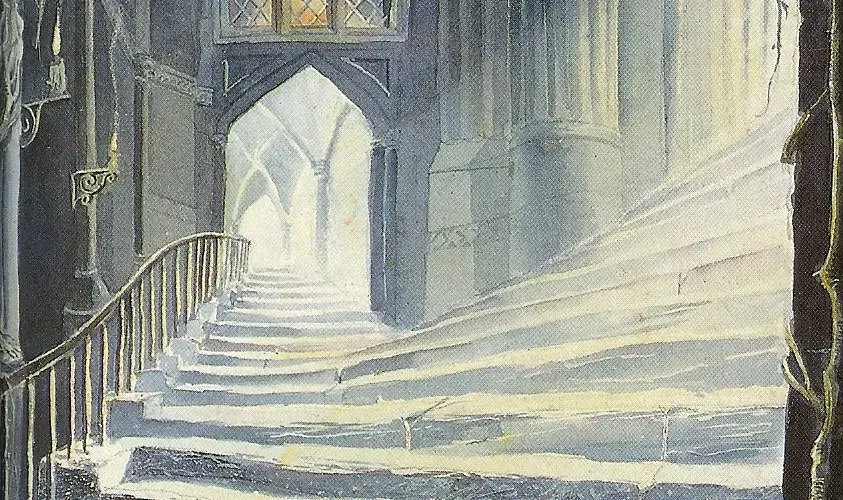
The whole book is built from sentences like that, and most of them earn their place. Some do not. Peake will describe a room, then describe it again in a different light, then describe the light. He will stop a scene to look at a staircase. The novel runs to about four hundred and forty pages, and the title character is a baby for nearly all of them. A reader who wants something to happen on every page will be cross with it by the third chapter.
My advice is practical. Read it the way you would walk round a great house, not the way you would cross a field to get home. Go slowly. Expect to stop. When a paragraph seems to be going round a second time, let it: the third pass is usually where the picture comes clear.
The rest of the shelf
Titus Groan is the first of three. Gormenghast followed in 1950 and Titus Alone in 1959, and both carry Titus’s story on. Peake meant to write more, but he became ill with a dementia that ended his working life, and he died in 1968. His widow, the painter Maeve Gilmore, completed a fourth book from his notes, published as Titus Awakes in 2011.
C. S. Lewis, the author of the Narnia books, who knew a strange book when he saw one, said that Peake’s books “are actual additions to life; they give, like certain rare dreams, sensations we never had before.”
One small mystery I have not solved and do not intend to. Sark, the island where the young Peake went to paint, kept a feudal system of government until 2008, with its own lord and its own ancient rules about who owed what to whom. Whether any of that crept into a castle where every act has been prescribed for centuries, I cannot say. Nobody can, I suppose. And perhaps it’s better that way.
Peake asks one question of his own that he never answers. Of Rottcodd, asleep in his hammock among the carvings, he wonders: “What were his reveries as he lay in his hammock with his dark bullet head tucked in the crook of his arm?” I have read the book twice and I still want to know.
The verdict is plain. Titus Groan is slow, sometimes too slow, but it is one of the most beautifully written in the genre. It has stood for eighty years and like Gormenghast itself, will stand a good deal longer. Do go and wander through it sometime.