



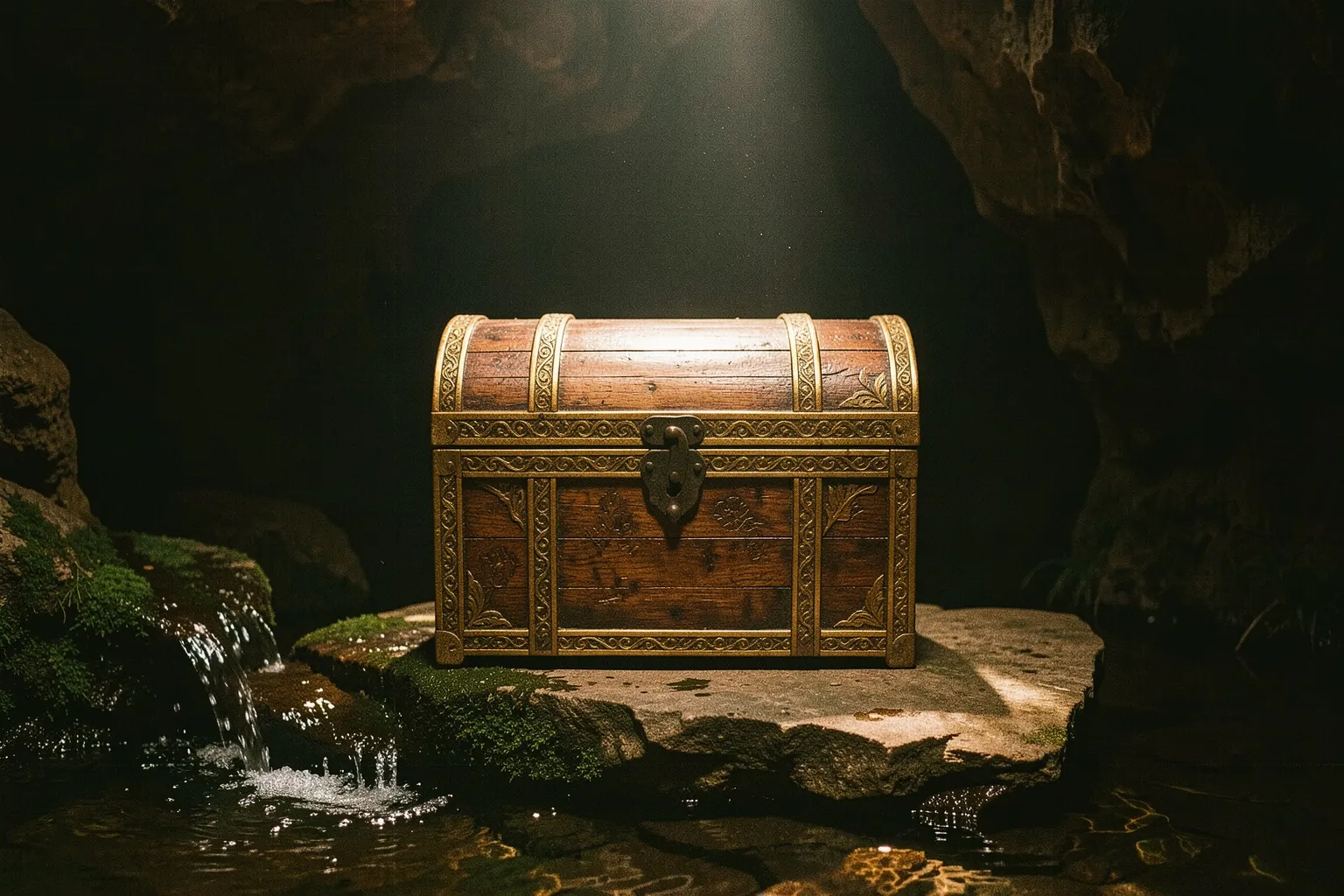
In the museum where I spent the better part of my working life, the finest things were very seldom in the main gallery. The main gallery held what visitors had come to see, which is quite proper. The treasures were in the storeroom drawers: a carved spoon nobody had held since 1912, a letter folded into a book by a reader long dead, a little incense box that had been waiting a thousand years for somebody to open it and say, “That smells pleasantly odd…”
This column is like that drawer, from which we will now and then retrieve a few books that have not had the readers they deserve. Some are old, some are recent, but none of them, so far as we can tell, sits on the shelf of an ordinary bookshop.
We shall tell you nothing that spoils them. We only want to put their names into your hands.
Silverlock, by John Myers Myers (1949)
John Myers Myers, an American who lived from 1906 to 1988, is better remembered, where he is remembered at all, for his histories of the Old West, among them The Alamo and a life of Doc Holliday. In 1949 the New York publisher E. P. Dutton brought out his fantasy Silverlock, and it did not stay in print for long.
Silverlock begins with a shipwreck. Its survivor is A. Clarence Shandon, a Chicago businessman with a degree from Wisconsin, a low opinion of nearly everyone and no interest whatever in the arts. He washes ashore in a country called the Commonwealth, whose every inhabitant has stepped out of a story, a poem or a legend. There he is taken up by Golias, a wandering bard of many names and doubtful habits, who nicknames him Silverlock and appoints himself his guide.
What follows is a journey through the whole of literature, made in the company of a man who has read none of it. Along the road are figures you will know, from Beowulf to Robin Hood, and a great many you will half know, and a few you will only recognise on the second reading, which is one of the book’s quieter delights. It is full of verse which begs to be read aloud.
Its provenance is the best part of the story. It was the readers who would not let it go. Science fiction fans adopted it, set its songs to music, sang them at their gatherings and kept asking for it back. It has been reissued several times since, most memorably in 1979, in a paperback carrying appreciations from the novelists Poul Anderson, Larry Niven and Jerry Pournelle, and in 2004, when NESFA Press, the publishing arm of the New England Science Fiction Association, brought it out with a companion volume identifying its people and places. Few books have been rescued so entirely by the affection of their readers.
It is, I should say, the perfect present for anybody who claims not to read fiction. Give it to them with a bar of good dark chocolate and say nothing.
Wizard of the Pigeons, by Megan Lindholm (1986)
You may already know this author by another name. In 1995, writing as Robin Hobb, she published Assassin’s Apprentice, which began one of the best-loved fantasy sequences of the last thirty years. Nine years before that, under the name Megan Lindholm, she published a strange and beautiful novel set on the streets of Seattle, with Ace Books.
Its hero is called Wizard. He is homeless, he is a veteran of the war in Vietnam, and he remembers very little of who he was before. He lives by a set of rules whose reasons he does not question, and he has a gift he calls the Knowing, which lets him see what is true about the people who pass him on the pavement and, now and then, to help them. And something from the past he has forgotten is not finished with him. Why he is the wizard of the pigeons, I shall leave you to find out.
The novelist and critic Jo Walton, rereading it, found it “glitteringly brilliant” at its best, and praised its “genuine fairytale feel and genuine fairytale logic”. That is exactly right. It is a fairy tale set on ordinary city streets, written at a time when there was barely a name for fantasy set in a modern city, and later guides to the genre count it as a key work in the making of what we now call urban fantasy. In France, where it was translated in 2003, it won the Prix Imaginales for best fantasy novel, and Le Monde called it a work of undeniable originality and great poetic strength.
It is a gentle book about a hard life, and it is tender towards the city it describes. Seattle has seldom been so well loved on the page. In 2020 Grim Oak Press published a thirty-fifth anniversary edition with illustrations, so it is easier to find now than it has been for years.
The Raven Tower, by Ann Leckie (2019)
Ann Leckie is an American writer whose first novel, Ancillary Justice, a space opera, won the Hugo, the Nebula and the Arthur C. Clarke awards. Readers who followed her into the stars may have missed that in 2019 Orbit published her first fantasy, and it is like nothing else on the shelf.
The port city of Vastai is protected by a god called the Raven, who chooses a human ruler known as the Raven’s Lease. Mawat, the heir to the Lease, comes home with his loyal aide Eolo to find his uncle sitting where his father should be. Readers of Hamlet will recognise that shape at once. What the book does with it, I shall leave entirely to you.
What makes it extraordinary is who tells the story. The narrator is another god altogether, the Strength and Patience of the Hill, who lives in a large boulder and has done for a very long time. It addresses Eolo throughout as “you”, as though talking quietly to a guest who cannot hear it, and it is in no hurry whatever. A stone has time. Between the chapters of Mawat’s trouble, it tells you its own history, which runs back a very long way indeed.
I have rarely met a narrator with such good manners, and I have known a great many old objects. It is a novel about gods and about the price of a promise, and it rewards a patient reader in the way the Hill itself would approve of.
Three books, then, from three different decades, each of which requires nothing from the reader but an evening (or three) and a comfortable chair. If you find them, we should be delighted to hear what you made of them. If you have a hidden gem of your own that you think the desk should know about, please write to us. We guarantee your correspondence will not fall into the drawer of forgotten things.
Kindest regards,
Findus Charvein, Editor in Chief