



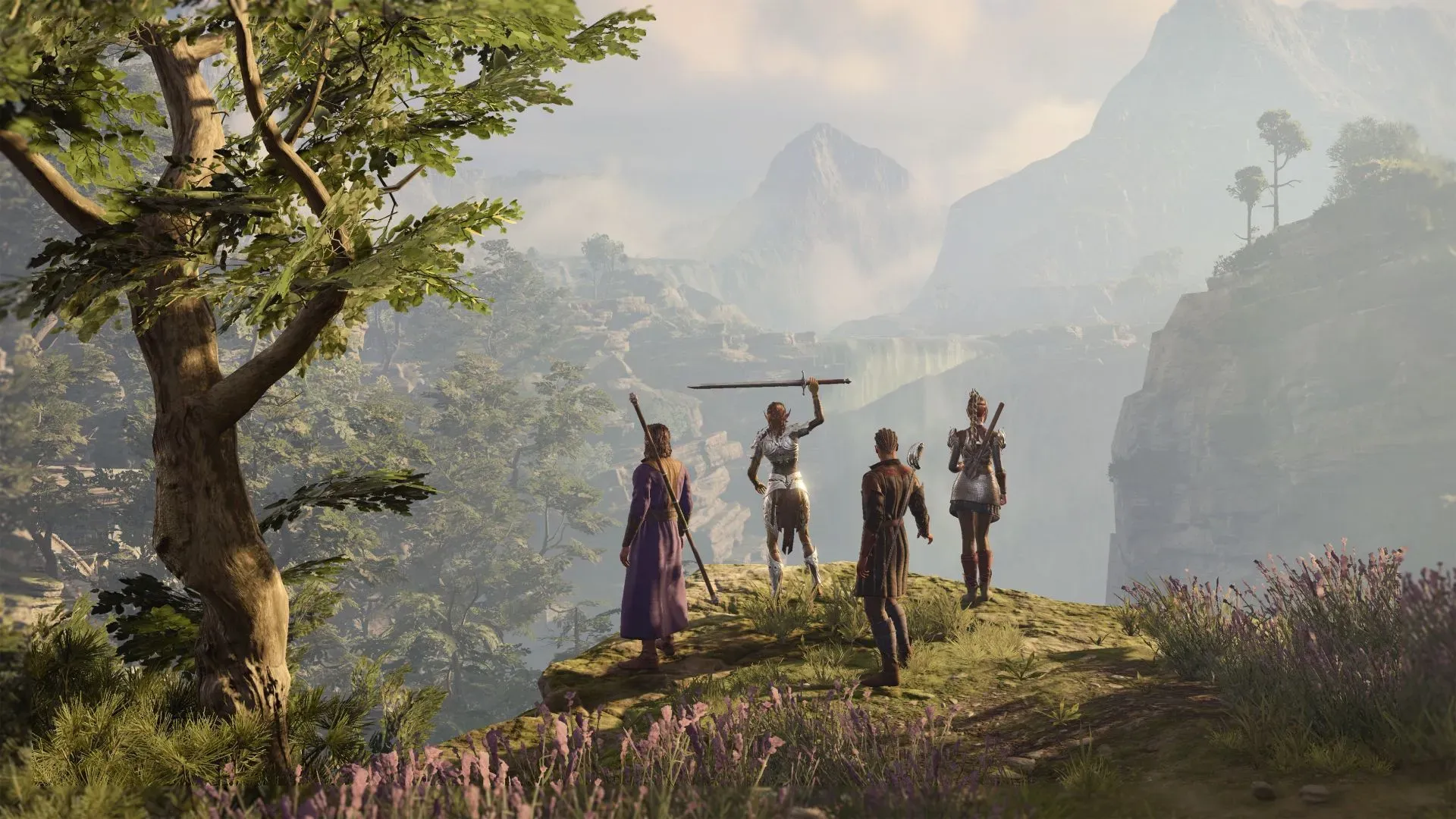
At the end of my game, Karlach went back to hell.
She is a tiefling, one of the horned, infernally descended peoples of Dungeons & Dragons, and a barbarian from the city of Baldur’s Gate. Years before the story begins, the man she worked for sold her to an archdevil, who tore out her heart and fitted an infernal engine in its place so that she could fight in the wars of Avernus, the first layer of the Nine Hells. She escaped. The trouble is that the engine was forged for Avernus, and in the ordinary air of the world above it runs hotter every day. By the last act of Baldur’s Gate 3 there are only three ways for her story to end: she stays and the engine kills her, she survives by letting herself be turned into a mind flayer, or she goes back down to the place she spent the whole game running from, because it is the only place her heart will keep working.
Mine went back. The last I saw of her, she was walking into the fire with a friend beside her, the one character in the game who most wanted to go home and the one for whom home was fatal. I have thought about that scene more than I expected to. Going back is not always the same thing as going home, and sometimes the place that keeps you alive is not the place you were from.
In a great many other people’s games, Karlach died in the city she grew up in. In others she lived on as something no longer quite herself. All three are the real ending. That is the difficulty facing anyone who wants to put Baldur’s Gate 3 on a page or a screen, and it explains the two adaptations that have arrived this year better than anything their makers have said about them.
A story with no fixed hero
Baldur’s Gate 3 is a role-playing game made by Larian Studios, a Belgian developer, under licence from Wizards of the Coast, the Hasbro company that owns Dungeons & Dragons. It came out in August 2023 and runs on the tabletop game’s own rules: attempts to persuade, sneak, lie or strike are settled by rolls of a twenty-sided die, and the ones that matter most are rolled in full view. In April 2024 it became the first game to win Game of the Year at all five of the industry’s major awards, and by the end of 2025 it had sold more than twenty million copies.
You begin aboard a mind flayer ship with a parasite in your skull, and you spend the next hundred hours trying to get it out. But who “you” are is not settled. You can build a character of your own from nothing, or take over one of six companions who are otherwise recruited along the way: Karlach, the vampire Astarion, the wizard Gale, the cleric Shadowheart, the soldier Lae’zel and the warlock Wyll. There is a seventh option, the Dark Urge, an amnesiac with a murderous inheritance whom you can steer towards it or away.
Every one of those choices changes what the companions say, what they will do for you and how their stories end. Larian has claimed seventeen thousand variations on the ending once every permutation is counted. Swen Vincke, the studio’s founder and the game’s director, defended the number after release: “Some of them are subtle, some of them depending on what your party composition is, but there’s quite a lot if you just look at the amount of the lines that had to do to the epilogues just to cater for it.”
Compare The Last of Us, which Craig Mazin, the writer of HBO’s Chernobyl, co-created as a television series for HBO in 2023. It was an adaptation in the plain sense, because the game it adapted has one story. Joel is always Joel. He makes the same terrible choice at the end of every playthrough, and the player cannot stop him. Baldur’s Gate 3 has no Joel. Its protagonist is the one character nobody can cast, because in twenty million copies he or she has been twenty million different people.
Going around
So the people adapting it have gone around the story rather than through it, and in opposite directions.
Baldur’s Gate 3: Astarion was published on 29 September by Random House Worlds, an imprint of Penguin Random House. It is by T. Kingfisher, the pen name of the American writer Ursula Vernon, whose dark fairy tale Nettle & Bone won the Hugo Award for best novel in 2023. In the game, Astarion is a high elf who was a magistrate in the city until a vampire lord called Cazador Szarr turned him into a spawn and kept him as a servant for two hundred years. The novel covers those years, ending before the game begins. One of the game’s senior writers, Stephen Rooney, was consulted on it, and Neil Newbon, who plays Astarion in the game, reads the audiobook. Kingfisher has warned readers that it is not light reading: “The book is DARK.”
The prequel is the one place where Astarion’s story is the same for everyone. Whatever a player later does with him, whether he finishes the ritual that frees him from his master’s hold and makes him something worse, or whether he is talked out of it, the two hundred years before the player met him happened exactly once. Nobody played them. A novelist can tell them without contradicting a single save file.
The HBO series, announced in February, goes the other way. Mazin will create, write and run it, and it is set immediately after the game ends. According to Deadline, which broke the story, it will follow a new party of inexperienced adventurers growing into their power, while the characters from the game turn up to help or hinder them. Mazin says he has played nearly a thousand hours of Baldur’s Gate 3, and his statement was generous to its makers: “I am a devoted fan of D&D and the brilliant way that Swen Vincke and his gifted team adapted it.”
Larian is not involved. The studio confirmed as much when the series was announced, and Larian has moved on to a game of its own. Chris Perkins, who spent most of three decades shaping Dungeons & Dragons stories at Wizards of the Coast, has been engaged as a consultant.
The last time somebody chose a hero
The first Baldur’s Gate, made by the Canadian studio BioWare in 1998, also let players create their own hero. In 1999 Philip Athans, an editor of the Forgotten Realms novels at Wizards of the Coast, wrote the novel of the game, and in doing so named that hero: Abdel Adrian, a human fighter. Players who had made a hero of their own have never much warmed to him. He remained the official version for long enough that a 2013 tabletop adventure, Murder in Baldur’s Gate, opened on the city celebrating him and then had him killed. When Larian brought two of the old games’ companions, Jaheira and Minsc, back for Baldur’s Gate 3, it wrote them as players of the old games remembered them.
The lesson Wizards seems to have drawn is the right one. Do not tell people who they were. A prequel avoids the question, and a sequel with new heroes avoids most of it.
Most, but not all.
The question that remains
A sequel still begins from an ending, and this one begins from several thousand.
Television has met this problem once already. Amazon’s Fallout, run by Geneva Robertson-Dworet and Graham Wagner with Jonathan Nolan as an executive producer, is also set after the games rather than retelling them, and its second season, released last December, travelled to New Vegas, the setting of a 2010 game whose climactic battle can end with any of four sides in charge. The showrunners refused to choose. Nolan called it “the fog of war approach”: “We had the delicious idea that at the end of a conflict, 15 years down the line, every faction might think they won.”
It is a graceful answer, and it works because a faction is a rumour. Fifteen years on, nobody in the Mojave quite agrees who won, and the audience does not need them to.
Karlach is not a rumour. If she walks on screen in the first season of Baldur’s Gate, she is alive, and she has not gone back to Avernus. If Astarion appears, the series has to decide whether he finished the ritual that would have made him a vampire lord, and there is no way to show him that does not answer it. The game’s companions are people rather than factions, and a face cannot be fogged. Every time one of them appears, the series will be telling some share of the people watching that their game did not happen.
I do not think that is a reason to dread it. A game like this was always going to be retold, by somebody, eventually, and the people retelling it are doing so with more care than the novel of 1999 managed. They have stopped short of the player’s own story in both directions, and that already shows they understand what is being entrusted to them.
When Vincke was asked whether any of Larian’s writers were helping with the show, he said not to his knowledge, but added that Mazin had asked to visit the studio, and that “from the conversation we had, I think he truly is a big fan, which gives me hope.”
A big fan who has played for nearly a thousand hours has his own ending. Perhaps the most honest thing the series could do is admit that its Baldur’s Gate is one playthrough among millions: Mazin’s game, told well. If his Karlach lived, I will be glad to see her, and my own will still be where I left her, down in the fire, warm at last.