



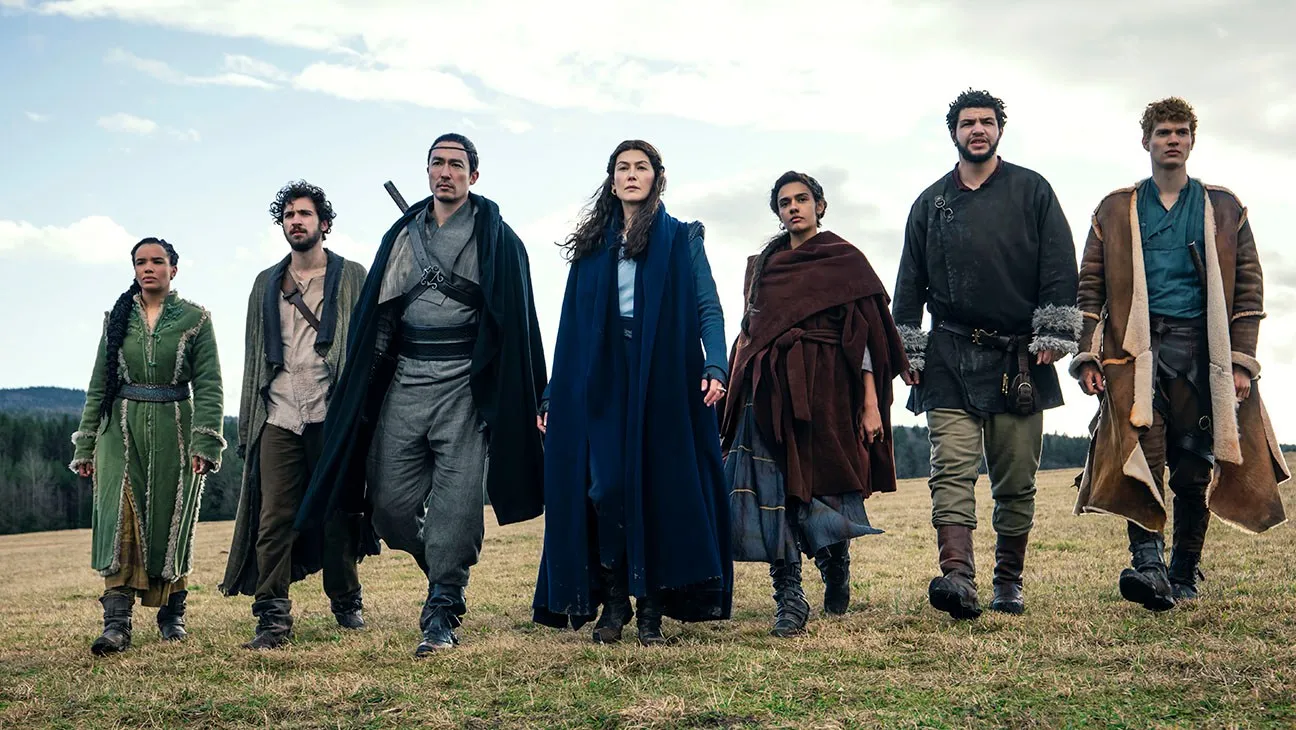
I write the guild column, which means I am the person on this desk who reads the contracts. Most weeks that is a quiet posting. Occasionally a story comes along in which the contracts are the story, and the fate of The Wheel of Time on screen is the clearest example I have seen in years.
Here is the shape of it. A television adaptation spent three seasons learning how to be good, arrived at genuinely good, and was cancelled four weeks later for reasons that had nothing to do with being good. The rights then returned to a rights-holder with a documented history of using the property to hold onto the property. And the revival announced in its place arrived with a promotional image that a great many people looked at and immediately suspected of having been generated rather than drawn.
None of those three things is a creative failure. All three are structural. That is what makes it worth writing about.
It got good, and then it was over
Let us be accurate about the quality curve, because the received wisdom (that the show was never any good) is simply wrong by the end.
Season one drew 81% on Rotten Tomatoes. Season two, 86%. Season three, 97%, with a Metascore of 75 and a user score of 9.1. Whatever you think of the earlier compromises, showrunner Rafe Judkins spent three years solving the adaptation problems in public and had substantially solved them by the third pass: the intersecting plotlines were being held in tension rather than shuffled, the cast had settled, and the season did the thing every long-fantasy adaptation must eventually do, which is make the scale feel like consequence rather than budget.
Amazon cancelled it in May 2025, a month after the finale.
Three seasons to find its footing, four weeks to be told the footing was too expensive. The show did not fail. It failed to fail quickly enough.
The arithmetic that killed it
The stated problem was not reception but cost against viewership: reportedly under 400 million weekly minutes, against a production cost somewhere in the region of $80–100 million a season. The programme was reportedly well-liked by the streamer’s own executives. It also, by several accounts, ranked as the most-watched title in a number of international markets, but the domestic figure is the one that clears the budget, and it did not.
This is the part worth sitting with, because it is not really about The Wheel of Time.
An epic fantasy adaptation has a shape that is fundamentally hostile to the way streaming services now measure success. The books are long; the cast is enormous; the world takes seasons to establish; the payoff is structurally deferred. The audience for such a thing accumulates: people arrive late, having been told by a friend that it gets good in season three. That is exactly the audience a weekly-minutes dashboard is worst at seeing, and exactly the patience that a $90 million line item is least likely to be granted.
So the genre finds itself in a bind of pure accounting. The form requires patience. The financing model cannot supply it. The Wheel of Time is not the first casualty and will not be the last, and the lesson every commissioner will draw is not “make it better” but “make it cheaper, or make it shorter, or do not make it at all.”
Who holds the wheel now
Which brings us to the ownership, and to the part of this story that genuinely troubles me.
The rights sit with iwot Studios, the company formerly known as Red Eagle Entertainment. Robert Jordan’s opinion of Red Eagle’s stewardship is a matter of public record and was not warm; asked about their handling of his work, he agreed that he was displeased in terms that left little room for interpretation.
Then there is Winter Dragon. In February 2015, a half-hour pilot of extraordinary cheapness was broadcast at 1:30 in the morning on FXX, without notice to Jordan’s estate, days before an option deadline. Its purpose was not to be watched. Its purpose was to constitute a use of the rights sufficient to retain them. It currently sits at 2.4 on IMDb, which is roughly what it deserves and entirely beside the point.
I raise this history not to prejudge the new projects but because the new projects were announced by the same rights-holder, and anyone assessing them is entitled to the context. The slate is ambitious: an animated series, an unspecified number of animated features, and a video game, developed with Thomas Vu (of League of Legends and Arcane) and Anthony Borquez’s Initiate Entertainment.
The image problem
And then the first look at Rand al’Thor, which a substantial part of the readership took one glance at and pronounced machine-made.
I have no proof either way and will not pretend otherwise. What I can report is why the suspicion attached so fast and stuck so hard. Borquez co-founded an artificial-intelligence entertainment firm. iwot has worked with Framestore on AI projects. And the image itself has the quality people have learned to recognise: technically smooth, compositionally inert, absent the specific decisions that make a drawn frame feel like somebody meant it.
The comparison being made everywhere is Arcane, and it is instructive. Arcane cost an enormous amount and took years because it was made by a very large number of people making a very large number of deliberate choices, and the result is the most persuasive argument in a decade that animation is a prestige medium rather than a cheap one. Invoking that lineage while shipping a first image that reads as generated is a positioning error at minimum.
What I will be watching
Not the trailer. The credits.
If the animated series is real, it will need a studio, a director, an art director, and several hundred named artists, and those names will appear in trade announcements long before any footage does. That is the tell. A production that intends to exist starts hiring; a production that exists to keep a rights clock from expiring does not.
I would love to be wrong about the pessimism here. Animation genuinely is the right answer to this adaptation (it always was), and a version that can put the full scope of the books on screen without an $90 million-a-season live-action bill is a version that could actually finish. Fourteen books deserve a form that can reach the end of them.
But the sequence matters. A well-reviewed show was cancelled for arithmetic; the property returned to a holder with a history of using cheap production to preserve options; and the revival’s first public artefact is an image nobody can confidently say a person made. Wheels turn, as the books like to observe. It is worth checking who is doing the turning, and whether they are being paid.