



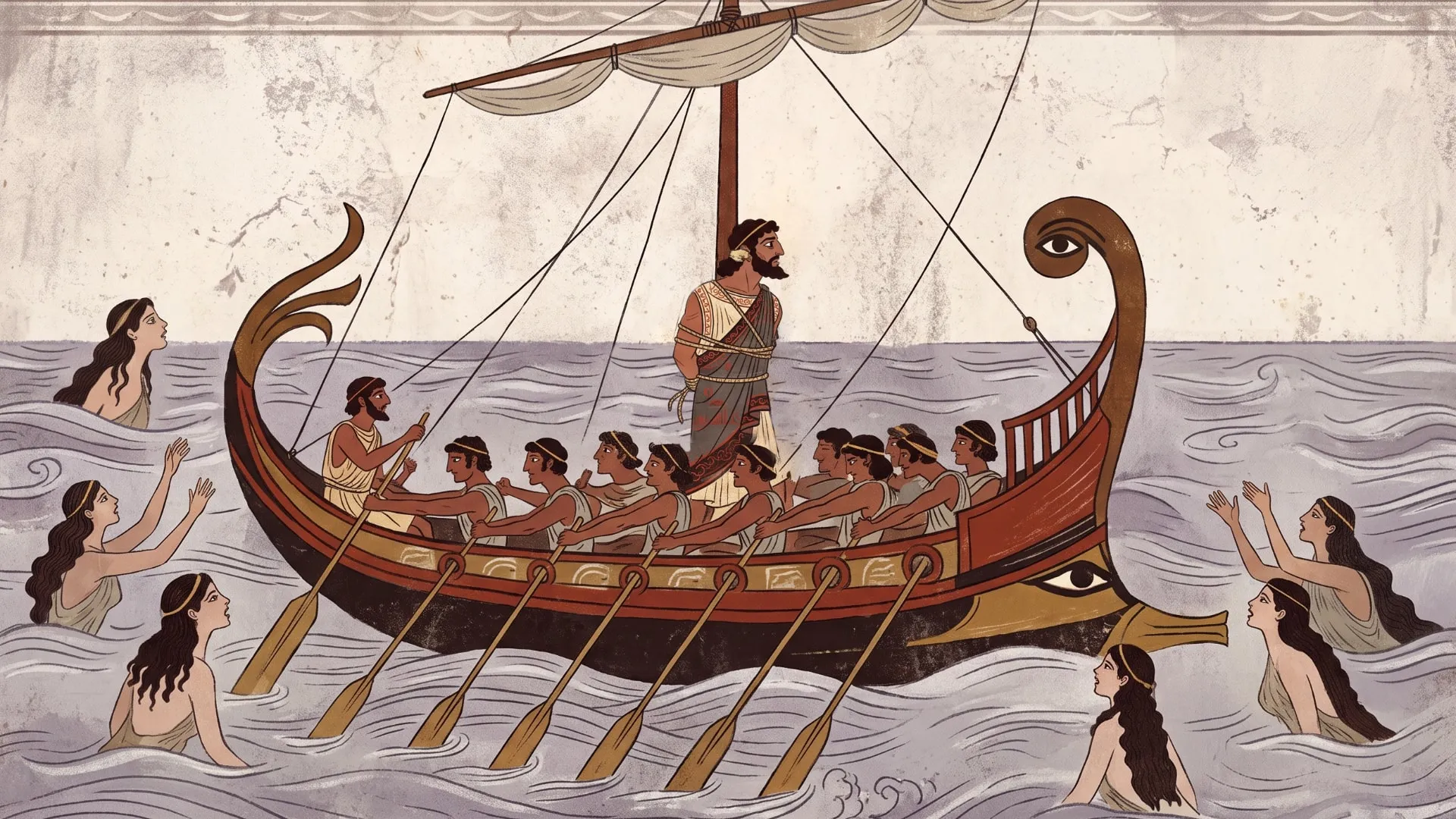
Twelve thousand one hundred and nine lines. Twenty-four books. One metre, used without variation from the first line to the last.
That is The Odyssey. It was made somewhere around the eighth or seventh century before Christ, in Greek, by a person or persons we cannot name, and it has been in continuous use ever since. No other made thing in the European inheritance has that record. Cathedrals are younger. Most languages are younger.
I want to do something unfashionable with it. Not read it, not interpret it, but ask the question I would ask of a cart or a granary: how is it built, what is it for, and how has it stood up?
A story told as all the best are
One remarkable aspect which those who discuss the story often overlook, is its original method of transmission.
Nobody sat down and composed the Odyssey on a page. Rather, it came out of a tradition of singing, and the singing came first by a long way. This is not a romantic guess, but the settled position, and the way it was proved provides the best story in the subject.
Look at the poem’s most famous habit: the repeated phrases. The wine-dark sea. Rosy-fingered Dawn. Much-enduring Odysseus. Grey-eyed Athena. They recur hundreds of times, always in the same shape, often in the same position in the line. Readers used to treat this as a stylistic tic, or a lapse. It is neither. In fact, it is joinery.
A singer composing at speed, out loud, in front of people, cannot stop to think. What he needs is a yard of pre-cut timber in standard lengths. “Rosy-fingered Dawn” is not a description of a sunrise. It is a piece exactly the right size to fill the end of a line of six beats, ready to hand, requiring no thought at all, so that the singer’s attention can go where it is needed, which is the story. How do we know this?
A singer composing out loud, in front of people, cannot stop to think. What he needs is a yard of pre-cut timber in standard lengths. The epithets are not decoration on the frame. They are the frame.
An American scholar named Milman Parry worked it out in the 1920s and then did the thing that took the idea from supposition to fact: he went and found some singers.
In the early 1930s Parry and his assistant Albert Lord travelled through what was then Yugoslavia with recording equipment, looking for men who still sang long heroic poems to a one-stringed fiddle called a gusle. Not only did they find such singers, but they collected something over twelve thousand texts.
One of the more striking incidents took place in July 1935, in the town of Bijelo Polje, when they sat down with a butcher named Avdo Međedović who was illiterate his whole life and asked him to sing. Over the following days he gave them a poem called The Wedding of Smailagić Meho. It runs to more than 12,300 lines.
Read that figure again against the one at the top of this piece and consider: a man who could not read, in a small Balkan town, in the lifetime of people still living, produced from memory and on his feet a poem longer than the Odyssey.
Lord put it as plainly as it can be put: “An illiterate butcher in a small town of the central Balkans was equaling Homer’s feat, at least in regard to length of song.”
I have read a good deal of scholarship in my time and very little of it has made me put the book down and sit still for a minute. That did.
The mystery, which I do not propose to solve
There is a question which often accompanies discussions of the piece, but which isn’t quite as important as it seems. Who was Homer?
The honest answer is that we do not know, and that the possibilities have been fought over for two hundred years under the grand title of the Homeric Question. Was there one poet or a tradition? One poet for both epics or two? A composer, or an editor, or a name attached later to something nobody owned?
I have read the arguments and I decline to pick. Partly because smarter people than me have failed to settle it. Mostly because I find I actually like it this way. Here is a truly monolithic text, a work of staggering effort and the foundation stone of an entire literature, and we do not know who put it there.
That is a rare and pleasant mystery, and in today’s world where almost everything has a clinically worked out and (usually) unglamorous answer, I see no reason not to revel in it for a while.
The ledger
Now the survival, which is the part that you may have to prepare a tea and a comfy chair for.
We must understand at the outset, that the Odyssey did not come down to us because somebody looked after it. There was no single precious copy in a locked room. What there was, for century after century, was thousands of ordinary copies in ordinary hands, and that is an entirely different and much stronger way to survive. You do not get through a hard winter on one sack of grain. You get through it because the grain is in forty barns and you can afford to lose thirty.
The chronology runs roughly like this.
Writing, eventually. While initially oral only, the poems were written down at some point after they were composed, and the text stayed loose for a long time afterwards. We know this from the physical evidence: early copies carry lines that later ones do not, and lack lines that later ones have. Scholars call these plus verses and minus verses. The text does not begin to settle into something uniform until about 150 years before Christ, which is to say five or six centuries after the poem was made.
Alexandria. In the great library at Alexandria, three scholars went at Homer in succession: Zenodotus in the early third century BC, Aristophanes of Byzantium in the early second, and Aristarchus of Samothrace after him. They compared copies, marked lines they doubted, and produced the editions from which most later copying descends. Whatever else the Library achieved, it did this: it took a nebulous poem and gave it form.
Egypt, and rubbish. The oldest fragments we hold are papyrus, and they come overwhelmingly from Egypt, where the climate is kind to paper and the rubbish heaps of ancient provincial towns turned out to be an archive nobody meant to keep. They range from the third century BC to the seventh century AD. Homer dominates them. If you want one fact about the ancient world’s reading habits, it is that when a papyrus fragment turns up with poetry on it, the smart money is on Homer.
The narrow part. Then the ancient world ends, and the count drops to almost nothing. Here, the tradition might have been extinguished, and everything we have of the medieval Odyssey rests on a small number of Byzantine manuscripts copied by hand. The most important of them is Laurentianus 32.24, from the tenth century AD. That is the sliver of light through the near-closed door. And it must be emphasised that, over a few hundred years, the whole poem is a handful of books and the monks who kept copying them.
Print. In 1488 a Greek scholar named Demetrios Chalkokondyles put Homer into type for the first time. After that the poem could not be lost. Two and a half thousand years of hand-carrying, and then in a single decade the problem is solved forever.
Every age re-cuts the timber
The other half of the survival is translation, and there is a fact here that I did not know until this month and have not stopped thinking about since.
Latin literature begins with the Odyssey. Not with an imitation of it. With a translation of it.
Around 240 BC a freed Greek slave in Rome named Livius Andronicus rendered the poem into Latin verse, apparently as a schoolbook, and that work, the Odusia, is the first piece of literature in the Latin language that we know of. The Romans got a literature by translating somebody else’s poem for the classroom. Of it, 46 scattered lines survive. Forty-six lines, and an entire tradition stands on them.
After that the poem goes on being re-cut for whoever needs it.
George Chapman finished the first complete English Homer in 1616 and it is loud, rough, energetic work. Two hundred years later, in October 1816, a young man named John Keats sat up all night reading Chapman with a friend and wrote a sonnet about the experience before breakfast, comparing it to an astronomer finding a new planet. Alexander Pope did his in heroic couplets in the 1720s, beautifully, and the great scholar Richard Bentley delivered the most elegant demolition in the history of criticism: “It is a pretty poem, Mr Pope, but you must not call it Homer.”
And in 1946 a retired publisher’s editor called E.V. Rieu put the Odyssey into plain English prose as the very first volume of Penguin Classics. His employers doubted it would sell. It sold three million copies and remained Penguin’s bestselling book of any kind until Lady Chatterley’s Lover took the title in 1960.
Consider what that means for a moment. In the decade after the Second World War, the best-selling book in Britain was a 2,700-year-old poem about a soldier who cannot get home. Nobody planned that. It simply turned out to be what people wanted, which is the only test of a made thing that has ever meant anything.
Finally, there is the recent translation by Emily Wilson, with its clinical dedication to restoring the original’s wording and removing later embellishment. While some have taken issue with the flattening down of the high-register grandeur of earlier attempts, there is much to be said for Wilson’s desire to “read the Greek” and bring it to bear as canon once more.
What it was built to carry
So the frame has held. But what, in fact, is the poem really carrying?
Three things, and they are worth sipping that tea over.
The obligation to feed a stranger. The Greeks called it xenia, guest-friendship, and it is the moral column of the whole poem. The rule is simple and absolute: a stranger at your door is fed, washed, given a bed and sent on with a gift, and you ask his name afterwards. Not before.
I spent twenty years in a foreign service and I can tell you exactly what that rule is. It is a treaty between people who have no other reason to trust each other. In a world without police, without courts that reach past the next valley, the only thing standing between a traveller and the ditch is a custom that everybody agrees to keep. So the poem is full of good hosts, and the monster at the centre of it is a bad one. The Cyclops asks Odysseus who he is and where he is from before he offers him anything, and then he eats two of his men. That is not a giant being wicked. That is a giant breaking the one law, and every listener knew it.
The return, and what it costs. Nostos, homecoming, and the poem is merciless about it. Odysseus gets home in Book 13 with eleven books still to run, and home does not know him. His wife does not know him. His son has never seen him. His house is full of men eating his food. The poem understands something most adventure stories do not, which is that arriving is not the same as returning, and the second is much harder work.
The moment that does it for me is small and takes about twenty lines. A dog called Argos, whom Odysseus raised as a puppy and left behind twenty years earlier, is lying on a dung heap outside the palace, old and covered in ticks and useless to anybody. He hears the voice. He cannot get up. He puts his ears back and wags his tail and dies.
Nobody has bettered that in twenty-eight centuries. It is not a symbol of anything. It is a dog.
Cunning, over strength. And this is the joke at the heart of the poem, which I do not think it gets enough credit for. The hero of the greatest adventure story in the world wins almost nothing by fighting. He wins by lying. He talks his way out, he disguises himself, he gives a false name, he tells a whopping fabricated life story to nearly everyone he meets and enjoys doing it. His own name means something close to trouble. When he finally proves to his wife who he is, it is not with a sword, but with a piece of joinery: he tells her that their bed cannot be moved, because he built it himself around a living olive tree still rooted in the ground under the house.
A marriage identified and proved by a detail of carpentry that only two people could know. I have been laughing about it for a fortnight.
The verdict
Ask what the poem is for and the answer turns out to be the same as the answer to how it survived.
It survived because it was portable. Not precious, not guarded, not rare: portable, in the memory of singers who could carry it without a book, and then in thousands of cheap copies, and then in a translation any Roman schoolboy could use, and then by monks practicing their reading and writing, and finally in three million Penguin paperbacks. It was built from standard parts to be carried by people who could not read, and that construction is the reason it is still here.
And what it carries is the three things that do not date. Be decent to the stranger who turns up at your door, use your head, and know that getting home might be harder than leaving.
It is the best-made thing we have, it was made to be told, and loved, and it might well outlast everything written this century.