



The first thing you do in Breath of the Wild, after you have climbed out of the cave you woke up in, is stand at the top of a slope and look at a country you are told you used to know. Somewhere down there is a castle with something circling it. Everything between you and the castle is ruined, and nobody has cleaned any of it up, because everybody who might have done so died a hundred years ago.
I have been thinking about that opening for some months now, and about how strange it is that the most celebrated moment in the series is a man returning to a place he cannot remember and finding it beyond recognition anyway. It is the whole of the Zelda project in one shot. Not a story being told to you, but a story that has already happened and which changes every time you see it.
Which brings me to the argument fans have been having for twenty years. And to my suspicion that they have been arguing the wrong side of it.
The complaint
There are more than twenty Zelda games. They share a hero called Link, a princess called Zelda, a recurring evil called Ganon, a divided artefact called the Triforce and a sword called the Master Sword. They do not share a chronology that makes sense. Characters recur across centuries without explanation. Hyrule is destroyed, flooded, restored and destroyed again. The same sword is pulled from the same pedestal by young men who have never met.
For a quarter of a century this was treated as an unsolved puzzle, and Nintendo did not publish an official chronology until Hyrule Historia in 2011, the series’ twenty-fifth anniversary year. When it did, the result was a chart with three branches, each trying to explain why the games are so different.
That chart was a mistake, and I say so with affection for the people who made it and considerable sympathy for the pressure they were under.
A continuity can be contradicted. A myth cannot. Nintendo spent twenty-five years holding the more valuable of those two things and then gave it away.
What Hyrule actually is
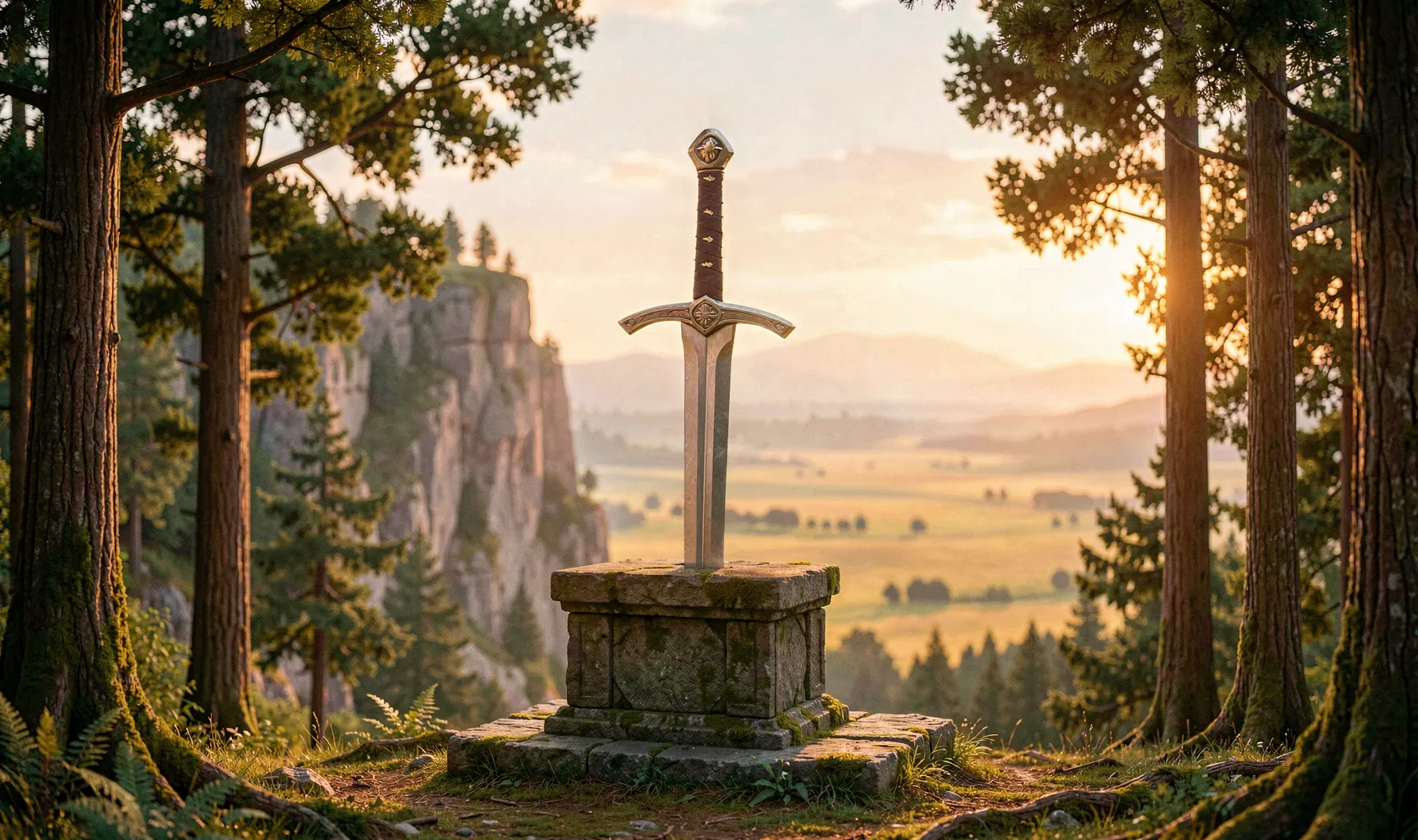
Consider another set of stories about a young man, a sword drawn from stone, a land that has fallen and must be redeemed, and a king who will come again.
Geoffrey of Monmouth wrote Arthur into a history of Britain around 1136, and largely invented what he claimed to be recording. Chrétien de Troyes, writing in French verse a few decades later, added Lancelot and the grail and rearranged a good deal of the rest. Sir Thomas Malory pulled the whole tangle together into English prose in the fifteenth century, and T.H. White took it apart again in the 1950s to make something gentler and sadder out of it. These versions contradict each other on almost every point of fact: who Arthur’s father was, how he got the sword, who betrayed him, whether he died.
Nobody considers this a problem. Nobody has ever asked for the official Arthurian timeline. The contradictions are not damage to the legend; they are the legend, because a story that survives being retold by hundreds of people over eight hundred years is necessarily a story that no longer agrees with itself. What holds it together is not continuity. It is a set of images strong enough to be recognised in any telling: the sword, the stone, the round table, the wound that will not heal.
Zelda is built exactly this way. A sword only the right person can draw. A triangle of power split three ways. A princess who is also a sage, a scholar, a pirate, a sheikah in disguise, or a wolf-haunted spirit, depending on which telling you have picked up. There’s a hero in green who is a different boy every time, and a darkness that is always imprisoned rather than killed, because imprisonment is a thing that can be undone later.
These are not franchise assets. They are the working parts of a legend, and Nintendo has been using them the way legends are used: reassembled from scratch, in a new order, for whoever is playing this time.
The people who made it have said so
Eiji Aonuma has produced this series since Ocarina of Time, and he has been saying the same thing in public for well over a decade. In 2012 he told an interviewer plainly that the chronology mattered less than the mechanics. In December 2023, speaking to IGN, he put it about as clearly as a producer can: “I don’t like to put too much stock in the chronology of the series, because from the design perspective, that can kind of box us in and limit where we’re able to take the story as we continue making games in the series.” The timeline, he added, is best left for people to interpret on their own.
That is not a man dodging a question. That is a man describing a method, and it is the method of every good teller of an old story: keep the images, drop the bookkeeping, take it somewhere it has not been.
The place it came from supports this too. Shigeru Miyamoto has told the story of his childhood in Sonobe so often that it risks sounding like a company legend, but it is worth repeating because it is a statement about form that is relevant here. He found a cave mouth in the woods, hesitated, went in with a lantern, and came out with the ambition that produced everything since: “I wanted to give players the feeling I had as a kid when I found that cave.”
Note what is absent from that sentence. There is no plot in it, and no cast. Just a place, a threshold and the decision to cross it.
1991: the ballad
A Link to the Past arrived in Japan on 21 November 1991 and in America the following April, directed by Takashi Tezuka with Miyamoto producing and Kensuke Tanabe writing, and it is the game that really gave the series its set pieces. The Triforce, the goddesses, the Imprisoning War in which the Seven Wise Men sealed Ganon away, the Knights of Hyrule, the Master Sword itself: all of it is introduced here, in one go, in 1991.
And nearly all of it is introduced in the instruction manual, which is to say outside the game entirely.
I find this genuinely moving rather than merely quaint. The backstory is delivered the way a ballad delivers one, in a block at the start, by a voice with no face, before anything happens. Then you are put down in the rain outside a castle and left alone with it. What story remains inside the cartridge is carried in short pieces of dialogue which, as with all the other Zelda games, are carried out by every character except Link. The protagonist is silent. The world is the storyteller.
Then, of course, there’s the map. In A Link to the Past, this is the real achievement. Hyrule is doubled. There is a Light World and a Dark World, laid over one another so that every hill, lake and village in the first has a corrupted counterpart in the second, and you travel between them through mirrors and portals. You do not read what happened to this country. You walk the same ground twice and see what became of it. A bridge here, a swamp there. A village of people, and then a village of the things those people turned into.
Nobody narrates this. It is simply true, underfoot, and the genius of this Zelda game it that it trusted geography to convey the story here, rather than relying on words.
1998: the myth acquires time
Ocarina of Time was released on 21 November 1998, seven years to the day after A Link to the Past, which was surely deliberate. It scored 99 out of 100 on Metacritic and has never been displaced from the top of that list.
It is remembered for the leap into three dimensions, and for the targeting system that made sword fighting legible in a moving camera. Those were the engineering. The storytelling innovation was something else entirely, and the series has been living off it ever since.
Naturally, you are once again Link, and you play the first act as a child. Then you draw the sword, and seven years pass while you are unconscious, and you come back to the same country as a young man to find that it went on without you. Hyrule Field is the same field. The market you ran through as a boy is rubble…and worse. The people who were kind to you have aged, or fled, or are dead, and the ones who remain do not know you. Then, because the game is generous and also cruel, it gives you the ability to travel back, so that you can stand in the good version of the place knowing exactly what is coming for it.
I do not think there is a cleverer piece of emotional architecture in any game I have played, and I think its cleverness is that it is not clever at all. It is just what returning feels like. Character in this series is almost never established by dialogue; it is established by taking you back somewhere and letting you notice the difference. Ocarina is where that was invented, and it is why the hollow, beautiful emptiness of Breath of the Wild works nineteen years later on people who could not name a single thing that happened in the plot.
The ending of this game does something that ought to settle the timeline argument by itself. Ganondorf is sealed by the sages, and Zelda sends the boy back to his own childhood so that he can have the years he lost. Which means the story finishes in two places at once: a Hyrule where the hero grew up and won, and a Hyrule where a seven-year-old walks back into a world that no longer needs saving and tells a princess about a future that will not now happen.
The game manufactures its own contradiction. It ends twice. Any chart drawn afterwards is drawing around a hole the story put there on purpose.
2017: the tale in fragments
A new telling arrived on 3 March 2017, when Breath of the Wild was released. Directed by Hidemaro Fujibayashi and produced by Aonuma, it has sold nearly thirty-six million copies, more than any other game in the series. The team spoke at length the same year about having set out to break the series’ conventions on purpose, chief among them the assumption that a player should do things in an order somebody else chose.
Everyone noticed what that did to the map. Rather fewer noticed what it did to the story, which is the more radical thing.
The plot of Breath of the Wild has already happened. The Calamity came a century ago, the hero fell, the champions died, the princess has been holding the thing at bay alone ever since, and you arrive long after all of it with no memory. What remains is recoverable only in pieces. An old woman in a village hands you twelve photographs of places you cannot identify and tells you to go and find them, in whatever order you like, or never. Each one, stood in, returns a scene. When you have all twelve she gives you a thirteenth.
Consider what that actually is. A story arriving in fragments, out of sequence, from whoever you happen to meet, assembled differently by every person who receives it and complete for almost nobody. That is not a modern experiment. Rather, it is the character of a tale passed along by mouth for a few hundred years, reproduced deliberately, by a company with a budget, in 2017.
The rest is told by the wreckage. You learn who lived where, and sometimes learn nothing at all, by climbing on the ruins of houses. You learn how bad it got by counting the guardians rusting in the grass outside the castle. There is no narrator for any of this. There is only the country, lying where it fell, exactly as in the Dark World twenty-six years earlier, and once again nobody explains it to you.
Twelve photographs, in any order you like, or never. That is not an experiment. That is what an oral tradition does, rebuilt on purpose by a company with a budget.
What it costs, because it does cost something
The method has a price, and Breath of the Wild pays it in full.
If a story can be received in any order, then no part of it may depend on any other part. Nothing can build. Every memory has to be independently legible, which means each one is a mood rather than a development, and the cumulative shape a novel would give you is simply not available. The Champions suffer worst: four characters who exist to be mourned, sketched in two scenes each, their stories deliberately thin precisely because thinness is what the structure can carry.
The greater loss is Zelda herself. She is perhaps the best-written character Nintendo has, a young woman failing publicly at a sacred duty she did not choose and cannot perform, watched by a father who will not forgive her for it, keeping a diary about a boy she resents for being effortless at the thing she cannot do at all. She is also, for the entire game, in the past tense. You cannot meet her. Everything you learn about her is a recording.
This was also the first Zelda game to give its people speaking voices, and I am still not certain the trade was worth it. Silence had been doing quiet work in this series for thirty years, leaving a gap the player filled. Fill it with an actor and you have gained a performance that adds debatably little.
None of which unmakes the achievement, mind. It only means the achievement has some rough edges, which tends to make it more loveable.
Which brings us to the film, and to the sequels nobody is discussing yet
There is a live-action The Legend of Zelda arriving on 30 April 2027, directed by Wes Ball, with Bo Bragason as Zelda and Benjamin Evan Ainsworth as Link. Filming wrapped this spring. Nintendo is financing more than half of it and Miyamoto is producing, which is an unusual degree of control for a games company to insist on and probably a very good sign.
It will almost certainly make money. And the moment it does, somebody at Sony will commission a second one, and the shape of the second one is the actual decision facing everybody here.
I wrote in these pages three weeks ago about Narnia, and about four studios in a row buying seven short, tonally unalike books in the belief that they had bought a saga. They had bought a shelf. The failure was never the material; it was the shape the machine insisted on forcing it into, a fixed cast ageing forward through escalating stakes, which Lewis’s books are built to defeat.
Zelda is the same shape, with one enormous advantage: it already knows it. Nobody has to be persuaded that these stories are separable, because they were made separable, by people who said so out loud, for thirty-five years.
So the proposal is not complicated. Do not make a trilogy. Make a second Zelda film that shares the sword, the princess, the triangle and the darkness, and shares nothing else at all. New hero. New century. New Hyrule, drowned or ruined or freshly made. Let the second film be a sea voyage and the third a story told entirely in a ruined country a hundred years after everyone died. Cast different actors and do not apologise for it, because the recurrence of the name with a different face underneath is not a continuity error in this material. It is the premise.
There is a version of this that is not a franchise at all but an anthology, held together by images rather than by contracts, and it is both the braver commercial bet and the more faithful one. It has the additional merit of being unable to fail in the usual way. An anthology cannot have a bad third instalment that poisons the first two, because there is no third instalment. There is only another telling, and if one telling is poor you simply go and hear a better one, which is what people have done with Arthur for eight hundred years.
The risk, of course, is the opposite one. A studio with a hit and a spreadsheet wants a saga, and the pressure to publish a cinematic chronology and start reconciling it will arrive roughly ten minutes after the opening weekend figures do. That is the moment to remember what Hyrule Historia cost. The instant a legend acquires an official version it becomes a thing that can be got wrong, and every later teller is working under audit.
The door, left open
I keep coming back to that slope above the ruined castle, and to how much it resembles the feeling I have about my own way home, which I have not found yet and have not stopped looking for.
What Breath of the Wild understood is that a place you have lost is not less real for being lost, and that walking through the wreck of it is a way of knowing it rather than a substitute for knowing it. That is what the whole series has been doing since a boy in 1991 walked out into the rain towards a castle, and it is why it will survive whatever the cinema does to it. You cannot break a legend by telling it badly once. You can only break it by writing down one version and saying it’s the correct one.
So: let the film be just a version. Let it be an unashamed, particular, beautifully made version, with no obligation to agree with the next one. Malory was a version too, and he is the one we still read.