
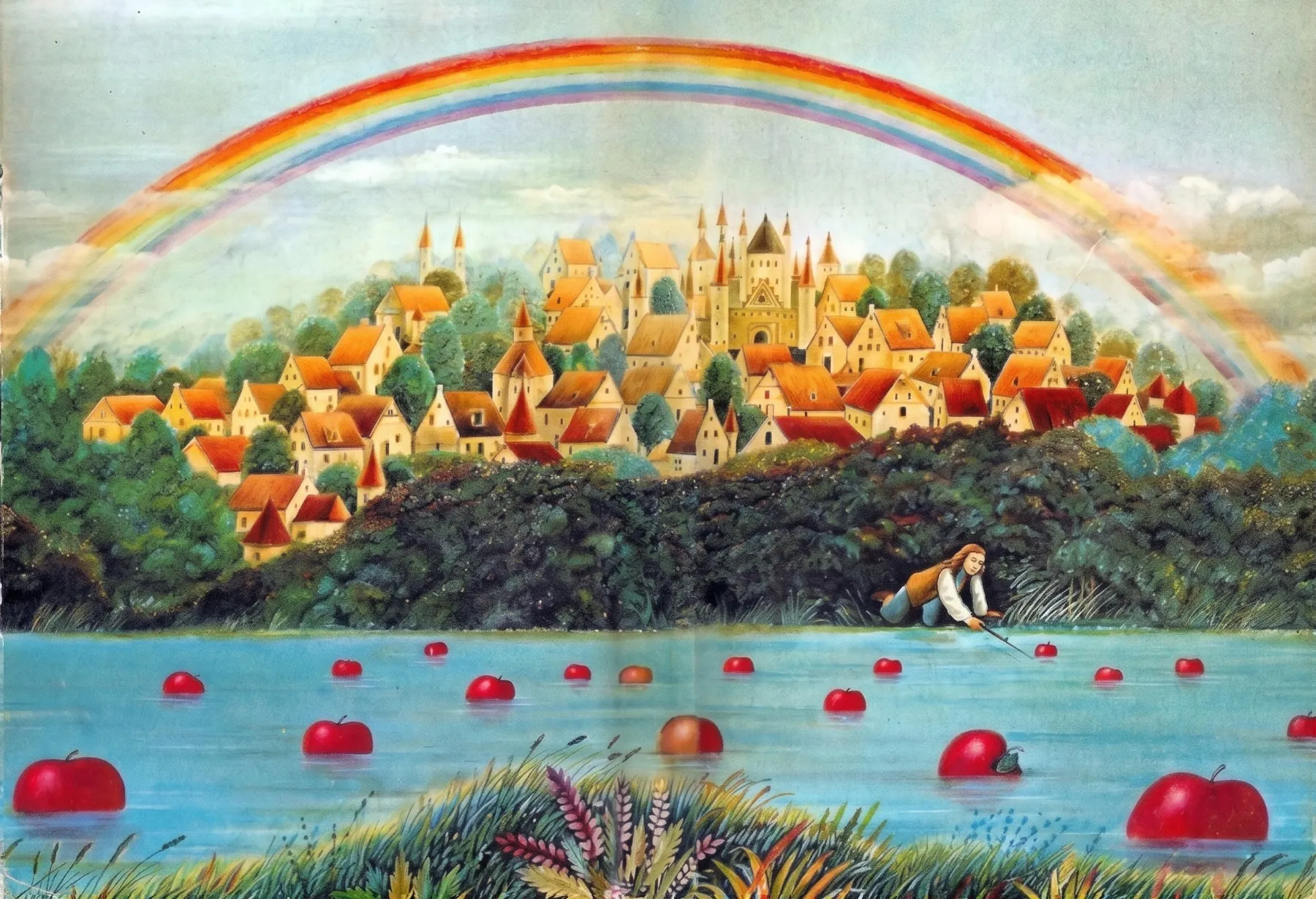
The Guildhall of Lud-in-the-Mist is built of mellow golden brick and covered in ivy, and “when the sun shone on it, it looked like a rotten apricot.”
That is in the first chapter, and it tells you almost everything about the book that follows. The town is old, comfortable and handsome, and something in it has gone very slightly off. The sentence both admires the scene and smells it at the same time.
Lud-in-the-Mist was published by Collins in 1926, a hundred years ago this year, and as far as I can discover no publisher is marking the occasion. It was the third and last novel of Hope Mirrlees, an English poet and classicist who studied Greek at Cambridge under the scholar Jane Harrison and lived with her until Harrison’s death in 1928. Mirrlees had already written Paris: A Poem, which Virginia and Leonard Woolf printed at their Hogarth Press, and Virginia Woolf called her “her own heroine”, and described her as “capricious, exacting, exquisite, very learned, and beautifully dressed.” Of all the descriptions of novelists I have read, the desire to invite one of them to dinner has never been so strong.
The town that banned the fairies
The Free State of Dorimare is a small, rich country with the sea to the south and mountains to the north and east. To the west, beyond the Debatable Hills, lies Fairyland. Its capital, Lud-in-the-Mist, stands where two rivers meet: the Dawl, broad and commercial, which carries the town’s trade, and the Dapple, a humble little stream that rises in Fairyland and flows underground beneath the hills.
Dorimare was once a duchy. Its last ruler, Duke Aubrey, was “a hunchback with a face of angelic beauty, who seemed to be possessed by a laughing demon of destructiveness.” An exquisite poet and a vicious prankster, the merchants rose against him and after three days of fighting in the streets he vanished, some said into Fairyland. The priests vanished with him. The merchants took the government, and with it they placed a taboo on everything to do with Fairyland, above all on fairy fruit, the eating of which they blamed for the Dukes’ decline. The fruit had always been connected with “poetry and visions”, and the new men had no use for either.
Here is the stroke of genius. The merchants, being merchants, founded a science of law, and in the eye of that law neither Fairyland nor fairy things exist. So when fairy fruit is smuggled into the town, as it always is, it cannot be prosecuted as fairy fruit. The magistrates invent “a legal fiction” that “turned fairy fruit into a form of woven silk and, hence, contraband in Dorimare.” When a case finally comes to court, Mirrlees reports that “many days were wasted in a learned discussion of the various characteristics of gold tissues, stick tuftaffities, figured satins, wrought grograines, silk mohair and ferret ribbons.”
To me, the court of Dorimare sounds like it too more time than a fitting at my father’s tailor, and with rather less to show for it at the end. But the joke has a blade in it. A lawyer in the book, the hero’s father, writes that the men of the revolution “had substituted law for fairy fruit”, and that as “fairy was delusion, so was the law”. The town has not abolished enchantment so much as nationalised it.
I confess the merchants lost me a little when the book described them “seeing that the tradesmen gave good measure and used standard weights”. I have never weighed anything in my life, though my landlady here in Barrel Town assures me that it matters.
The man who heard the Note
The hero is Master Nathaniel Chanticleer, the town’s mayor, “rotund, rubicund, red-haired”, a merchant of good family who passes for a perfectly ordinary Dorimarite and is nothing of the kind.
As a young man, exploring an attic with some friends, he plucked the rotten strings of an old lute and it gave out “one note, so plangent, blood-freezing and alluring, that for a few seconds the company stood as if petrified.” Somebody made a joke and the evening went on, but Nathaniel was never the same.
What the Note does to him the reader soon discovers. Before he heard it he had wanted to go to sea; afterwards “a more stay-at-home and steady young man could not have been found in Lud-in-the-Mist.” It gave him “a wistful yearning after the prosaic things he already possessed. It was as if he thought he had already lost what he was actually holding in his hands.” He walks home from the Guildhall naming the streets to himself and the dogs he passes, for the comfort of knowing them. He cannot bear to hear anybody say the phrase “never again.”
That is a portrait of a man in love with ordinary life because he has glimpsed what lies outside it, and it is written in so haunting a manner that I, too, have become restless thinking about it.
Then the thing he has dreaded all his life arrives, and it comes in by his own front door. The Note does not cause it. Fairy fruit has been smuggled into Dorimare for years, and the novel is the story of that trade finally reaching the mayor’s house; what the Note gave Nathaniel was the dread that one day it would, and an ear to recognise it when it did.
His son, Ranulph, confesses that he has eaten fairy fruit, slipped to him months before by Willy Wisp, a mischievous lad who once worked in the Chanticleer stables. Willy next turns up as the dancing master at Miss Primrose Crabapple’s Academy for young ladies, teaching the girls an old dance called “Columbine”, and soon afterwards the pupils, Nathaniel’s daughter Prunella among them, are reported flitting along the West Road towards the hills. Meanwhile Endymion Leer, the doctor called in to treat Ranulph, sings the boy to sleep with the nursery song of the same name, and in his voice Nathaniel hears the Note again, though his wife hears only a vulgar old tune.
The upshot is that Nathaniel, who has spent his life refusing the West, has to go there.
What Mirrlees could do that nobody else could
Two years before, in 1924, Lord Dunsany, the Anglo-Irish fantasist, had published The King of Elfland’s Daughter, which is in some ways the same book turned inside out. In Dunsany, the parliament of a dull little country called Erl demands to be ruled by magic, and its lord’s son goes into Elfland to fetch a bride. In Mirrlees, the town has had magic and outlawed it. Dunsany loves Elfland and finds Erl a bore. Mirrlees loves both, and that is the difference between a beautiful book and a great one.
Her town is as real as her Fairyland, and drawn with the same attention. It has a graveyard on a hill, a market, a harbour of red and tawny sails, oaths that swing in one breath from “by the Golden Apples of the West” to “Toasted Cheese” and “Suffering Cats”, and statues of dead citizens in the squares holding “levees attended by birds and lovers and insects and children.” When the uncanny arrives it does not change the prose. The same dry, amused narrator describes a pleached alley of hornbeams and notes that halfway down “it is not air that you are breathing, but silence, the almost palpable silence of trees”, and the hairs rise on your neck in a sentence that has not raised its voice.
No other fantasist of the period managed such fine command of the genre. The book never has to choose between being funny and being frightening, because Mirrlees understood that the comfortable and the strange are not opposites. Each is what makes the other visible, which is exactly what the Note taught Nathaniel.
The town has not abolished enchantment so much as nationalised it.
What the book leaves out, and how it came back
Lud-in-the-Mist is not a fast book. The middle chapters, given over to inquiries, legal arguments and a trial, ask for patience, its allusions are dense, and it does not always tell you which side it wants you on. That last is deliberate, and I count it a virtue, but a reader who wants a clear villain and a clear victory will want to look elsewhere.
Mirrlees did not write another novel. She lived on until 1978 and published little else, and the book slipped from sight. In 1946 the American critic Edward Wagenknecht called it “Hope Mirrlees’ unappreciated masterpiece”, which suggests how few had read it, even then. And in 1970, Lin Carter, editing the Ballantine Adult Fantasy paperbacks in America for the house that had brought Dunsany’s novel back the year before, reissued Lud-in-the-Mist without her permission. Carter had tried to find her and failed. The novelist Michael Swanwick, who has written a book-length study of her, found no record that she ever learned her book was in print again.
It has stayed in print since, in the Fantasy Masterworks series from 2000 among others, and in 2021 BBC Radio 4 adapted it. Swanwick called it “one of the least known and most influential of modern fantasies”. The critics David Langford and Mike Ashley described “a moving book, shifting unpredictably from drollery to menace to a high poignancy that sticks in the mind.” Both are right, with neither quite nailing how funny it is.
No spoilers
The book is dedicated to the memory of Mirrlees’s father, and it carries an epigraph from Jane Harrison about the Sirens, the voices calling a man to his heart’s desire, “to which if he hearken it may be that he will return no more.” I will not spoil the ending, save to say that it honours both, and that reconciliation, when it comes to Dorimare, comes partly in the form of an export trade in candied fruit, sold abroad in pretty boxes whose painted lids “showed that art was creeping back to Dorimare.” A more civilised conclusion to a war between the real and the unreal will be most difficult to find.
Between Dunsany’s Elfland in 1924 and Tolkien’s hobbit-hole in 1937, nobody wrote a finer fantasy in English than Lud-in-the-Mist. Pick it up, give it a read, hear the note it plays, and perhaps you too will find yourself changed. I guarantee it will be in a far nicer way than Nathaniel was.