



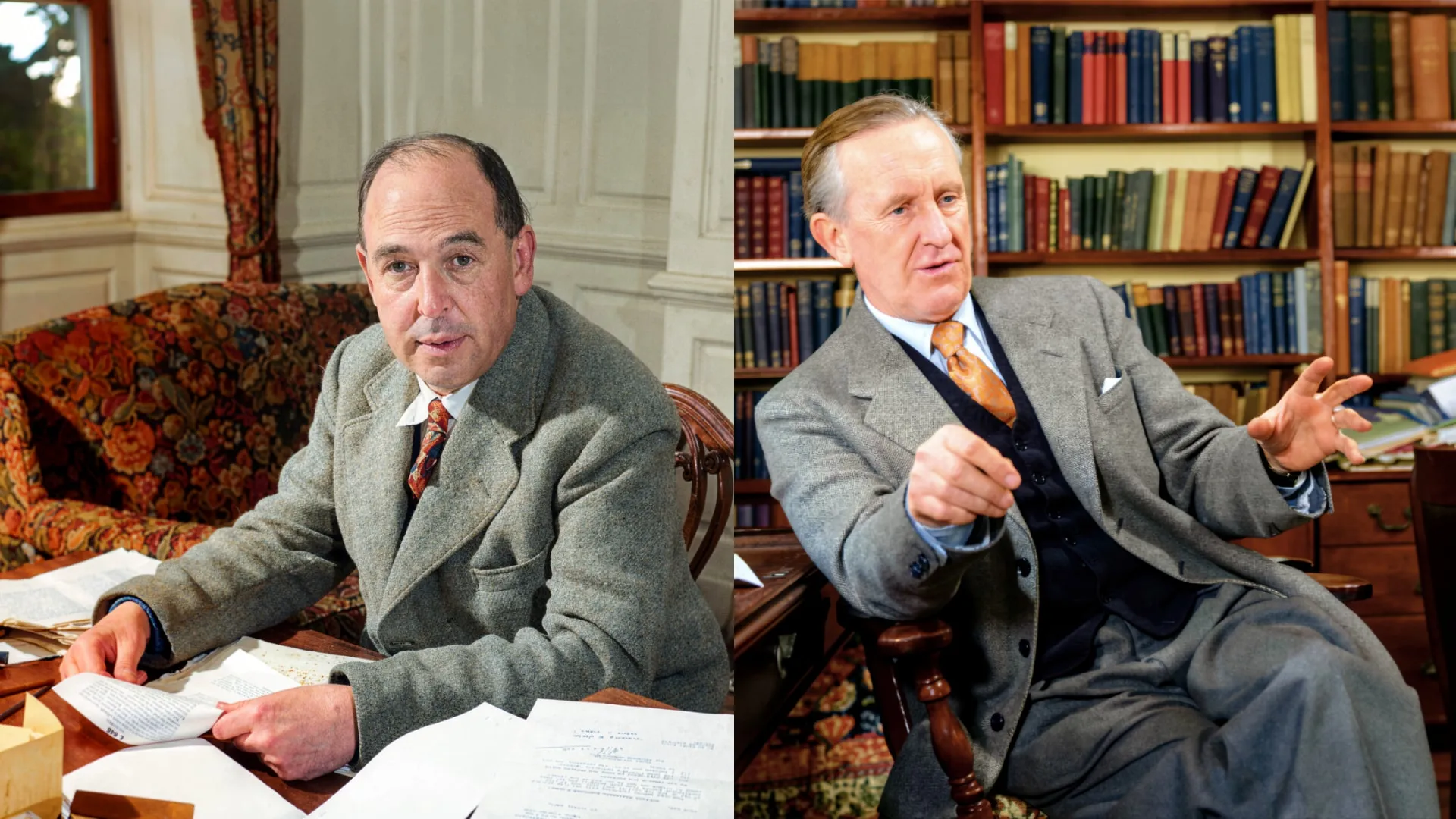
On the afternoon of 11 May 1926 the English Faculty of Oxford University met at Merton College. Among those present was C.S. Lewis, twenty-seven, a tutor at Magdalen with a reputation for argument and no religion to speak of. He went home and wrote down what he had made of a colleague he had just been introduced to: “He is a smooth, pale, fluent little chap … No harm in him: only needs a smack or so.”
The smooth pale chap was J.R.R. Tolkien, thirty-four, Professor of Anglo-Saxon, and he did not need a smack. What he needed, though neither man could have known it, was a reader. He had spent a decade inventing languages and writing a mythology to give those languages somewhere to live, and he had shown it to almost nobody, because there was almost nobody to show it to. Within a year the two of them were meeting to read Icelandic aloud. Within five, one of them had changed the other’s religion. Within thirty, they had between them produced the two most widely read invented worlds in the English language, and had largely stopped speaking.
I want to set out how that happened, because the popular version has hardened into something tidier and less interesting than the truth: two Christian dons in a pub, one bearded and slow, one bluff and quick, cheerfully producing Middle-earth and Narnia between pints. The friendship was real and it was warmer than that. The disagreement was real too, and it was not about taste. It was about what a story is for, and it is the single most useful argument in the genre.
Two men and a want of company
Firstly, let’s look at what they had in common, which was a great deal.
Both had lost their mothers as boys. Both had gone to the First World War and come back, Lewis wounded at Arras, Tolkien invalided out with trench fever after the Somme, and both had lost close friends there in numbers that do not bear setting out. Both loved the literature of the north: Norse sagas, Old English, the particular cold flavour of a story in which the heroes lose. And both had arrived in a university English faculty that regarded such things as a preliminary to the real business of literature, which began somewhere around Chaucer and improved steadily thereafter.
Tolkien had spent a decade inventing languages and writing a mythology to give those languages somewhere to live, and he had shown it to almost nobody, because there was almost nobody to show it to.
Tolkien had founded a club to address this: the Kolbítar, an Icelandic word meaning coal-biters, which is what you call men who sit so close to the fire they are practically eating it. The business of the club was reading Norse sagas aloud in the original, slowly, by people who mostly could not do it very well. Lewis joined. He was not a philologist, which is to say he was not a man who studies how languages change over centuries, and Tolkien very much was, so Lewis did the reading badly and enjoyed it enormously.
Out of this came the Inklings, a reading group which has since acquired a mystique it could not have anticipated. It met on Thursday evenings in Lewis’s rooms at Magdalen and on Tuesday mornings in a pub called the Eagle and Child, and its method was that somebody read work in progress aloud and everybody else said what they thought, at length, with no allowance made for the author’s feelings.
This matters more than the anecdotes about beer. The Lord of the Rings was heard before it was read, chapter by chapter, over more than a decade, by a small room of men who would tell you if a passage was dull. You can hear it in the finished book. The pacing of that novel is the pacing of something composed for the ear and tested on an audience that was physically present, and there is no substitute for that arrangement. It is the difference between a dish cooked for guests who are already sitting down and one photographed for a book.
The walk on Addison’s Walk
On the night of 19 September 1931, Lewis, Tolkien and a third friend, Hugo Dyson, walked along Addison’s Walk, a tree-lined path beside the river in the grounds of Magdalen College, and talked until three in the morning.
The subject was myth. Lewis at this point had arrived at God but not at Christianity, and his obstacle was specific and, to my mind, entirely respectable. He loved the old stories of dying and rising gods. He found them moving and beautiful. And he did not believe a word of them. Nor could he see why the Christian story should be exempt from that judgement, because it looked to him like one more of the same, merely with better public relations.
Tolkien’s answer is the hinge of the whole century that follows. He did not argue that the other myths were false and this one true. He argued that the pagan myths were not lies at all, but glimpses, fragments of something real caught by people working with insufficient light, and that in the Christian story the same shape had for once arrived in history with a date and a place attached. The old myth, in his phrase, had become fact.
Nine days later Lewis climbed into the sidecar of his brother’s motorcycle to go to Whipsnade Zoo. He recorded afterwards that when they set out he did not believe that Jesus Christ was the Son of God, and that by the time they reached the zoo, he did.
Two things follow from that crucial moment, and they pull in opposite directions.
The first is that the friendship now had a foundation under it, and both men knew it. The second is that Tolkien, a Roman Catholic, had converted his friend to Christianity and then watched him go back to the Church of Ireland he had been raised in, which was not the outcome intended. He never entirely stopped being disappointed about it.
The wager
Around 1936 Lewis said to Tolkien: “Tollers, there is too little of what we really like in stories. I am afraid we shall have to try and write some ourselves.”
They divided the work. Lewis would take space travel and Tolkien would take time travel. Lewis went away and wrote Out of the Silent Planet, a novel about a philologist kidnapped and taken to Mars, and published it in 1938. Tolkien went away and wrote a few chapters of The Lost Road, ran into the fact that what he actually wanted to write was the fall of Númenor, and abandoned it.
Everything about the two men is in that result, and I would not labour it except that almost nobody notices it. Lewis was a finisher. He was fast, fluent, disciplined, and constitutionally unable to leave a thing alone until it was done. Tolkien was not slow, exactly, but he was incapable of finishing anything he had not first made entirely true, which in his sense meant the languages, the calendars, the descent of the kings and what the moon was doing on a certain night in a certain age.
Lewis was given space travel and finished it. Tolkien was given time travel and did not. Everything about the two men is in that result.
Lewis published more than thirty books in as many years: literary criticism of the first rank, popular theology, science fiction, an autobiography, a novel about Cupid and Psyche, and seven children’s books. Tolkien published The Hobbit, The Lord of the Rings, and a small handful of shorter things, and left behind a legendarium so ponderous and unfinished that his son spent four decades editing it into print after his death.
Here is the part that ought to unsettle anybody who prefers one of these men to the other, however. Without Lewis, the long book does not exist.
Tolkien said so himself, in 1965, two years after Lewis had died. “The unpayable debt that I owe to him,” he wrote, “was not ‘influence’ as it is ordinarily understood, but sheer encouragement. He was for long my only audience. Only from him did I ever get the idea that my ‘stuff’ could be more than a private hobby. But for his interest and unceasing eagerness for more I should never have brought The Lord of the Rings to a conclusion.”
The book took twelve years, written in the margins of a working life, in a house with children in it, by a man who marked school examination papers for extra money because a professor’s salary did not stretch. I have had that last arrangement explained to me twice and I remain troubled by it. What is not in doubt is that the manuscript needed somebody in the room who wanted the next chapter, and for most of those twelve years that person was Lewis and nobody else.
He kept it up in public, too. When The Fellowship of the Ring appeared in 1954 Lewis reviewed it in Time and Tide and wrote that here were “beauties which pierce like swords or burn like cold iron; here is a book that will break your heart.” In 1961 he nominated Tolkien for the Nobel Prize in Literature. The committee chairman, Anders Österling, dismissed the candidacy on the ground that the prose “has not in any way measured up to storytelling of the highest quality,” and gave the prize to Ivo Andrić.
I hold no brief for prize juries, who are wrong roughly as often as they are asked. But it is worth pausing on the fact that the objection was to the prose, since that is now the standard objection and it was already being made in the year the ink dried.
Allegory, and the word Tolkien preferred
Now the argument.
In 1966, in a foreword to the second edition of The Lord of the Rings, Tolkien set out his position in a sentence that has been quoted ever since and understood about half the time: “I cordially dislike allegory in all its manifestations, and always have done so since I grew old and wary enough to detect its presence. I much prefer history, true or feigned, with its varied applicability to the thought and experience of readers.”
Two words are doing the work there, and they are worth having plainly.
Allegory is a story in which the parts stand for particular things by the author’s design. The lion means this, the winter means that, and the meaning was decided before the story was written and is not up for negotiation.
Applicability is what happens when a story is simply true to itself, and a reader brings their own life to it and finds that it fits. Nothing was assigned. The fit is the reader’s discovery, and two readers may find different fits and both be right.
Tolkien’s whole method rests on the second. He was famously irritated by people who read the Ring as the atomic bomb and the War of the Ring as the war he had lived through. Not because the resemblance was absent, but because assigning it meant closing a door he had gone to enormous trouble to leave open.
Lewis went the other way, and did it deliberately. Aslan is not merely a code for Christ; Lewis was careful about this and the distinction is a real one. He described the books as supposal rather than allegory: suppose there were another world, and suppose the Son of God entered it not as a man, as he had in ours, but as a creature fitting for that world. But the supposal is still authored. The lion is doing a particular job, which the reader does not have to work hard to grasp, and Lewis, who had spent his professional life writing about allegory and produced a landmark study of it, knew exactly what he was doing.
So did Tolkien, which is why it annoyed him.
What Tolkien actually said about Narnia
Here the received account needs handling with more care than it usually gets, and the paper’s habit is to state the other side at its strongest.
The famous version comes from Roger Lancelyn Green, a friend of both men. Tolkien, having heard The Lion, the Witch and the Wardrobe read aloud, is supposed to have said: “It really won’t do!” The complaint is generally given as eclecticism. Narnia contains fauns from Rome, dwarfs from the north, a witch out of Andersen, talking English schoolroom animals, and, in the same book as the crucifixion of a god, Father Christmas. To a man who had spent forty years making sure that every name in his own world came from a language he had built himself, this was not a world at all. It was a toy box that somebody had tipped out.
That is a real objection and I have some sympathy with it. But the evidence for Tolkien’s hostility is thinner than the anecdote suggests, and it is worth saying so. Josh B. Long went through the accounts for Mythlore in 2013 and found most of them second-hand, recorded years later, and mutually inconsistent. The one clearly published statement in Tolkien’s own hand is a mild regret that “Narnia and all that part of C.S.L.’s work should remain outside the range of my sympathy.” That is a man saying a book is not for him. It is a considerable distance from contempt, and the distance has been quietly filled in by people who enjoy a feud.
And on the merits, the objection is answerable. The rummage is the method. A child of seven does not hold a consistent mythology; a child of seven holds Father Christmas and a Roman faun and a talking beaver simultaneously and sees no difficulty whatever, because that is what the inside of a read-to childhood actually contains. Lewis was not building a world. He was reproducing a state of mind, and he did it so exactly that the books have sold something like 120 million copies in 47 languages and are still, seventy years on, the way a great many people first find out that a wardrobe might not have a back to it.
What Lewis leaves out is depth: the economies, the histories, the sense that the place carries on without you. What Tolkien leaves out is people: interiority, domestic life, marriage, and women in any number worth counting. Each man’s great strength is exactly the other’s omission, which is the usual arrangement between friends and the reason they were useful to one another for as long as they were.
The separation
The friendship cooled, and the causes are not mysterious and not discreditable to anybody.
Charles Williams arrived in Oxford in 1939, a novelist and theologian of considerable strangeness, and Lewis fell for him intellectually in a way Tolkien found baffling and, one gathers, a little wounding. In 1954 Lewis was elected to a chair at Cambridge, and Oxford friendships do not survive a train timetable as well as their participants expect. In 1956 he married Joy Davidman, an American divorcée, and Tolkien learned of it from somebody else. That was the part that stung.
Tolkien’s own summary is the only one worth having. Four days after Lewis died, on 26 November 1963, he wrote to his daughter Priscilla: “So far I have felt the normal feelings of a man of my age, like an old tree that is losing all its leaves one by one: this feels like an axe-blow near the roots.” And then, without any attempt to tidy it: “Very sad that we should have been so separated in the last years; but our time of close communion endured in memory for both of us.”
Very little can truly describe the loss of a great friend. These two sentences manage in prose Lewis himself would have appreciated.
What the argument left us
Two bodies of work, both enormous, built on the same belief and pointed in opposite directions.
Lewis wrote seven books in six years and made a door in a piece of bedroom furniture, and the reason children go through it is that it promises all the fantasy they can handle without explanation. Tolkien wrote one book in twelve years and made a world according to weight and measure, and the reason adults stay in it is that nobody can fail to admire the view.
We need not choose one or the other. We should notice that the argument between them was never settled, that it cannot be settled, and that the whole modern genre is still being written inside it: every author who assigns a meaning and every author who refuses to is taking a side in a conversation that started on a path beside a river in 1931 and has not stopped since.
That is what a good friendship is for. It leaves the argument open behind it, and there is no higher use to which two men have ever put an evening.