



Every reader keeps a shelf of unfinished things. Mine is not large, and it is very quiet, and two of Patrick Rothfuss’s books have been standing on it since 2011.
The argument about the third book has run so long that people have started to discuss the silence as though the silence were the work, but it is not. ‘The work’ is two novels of genuinely unusual craft, and the only reason anybody minds the waiting part is that they were simply that good.
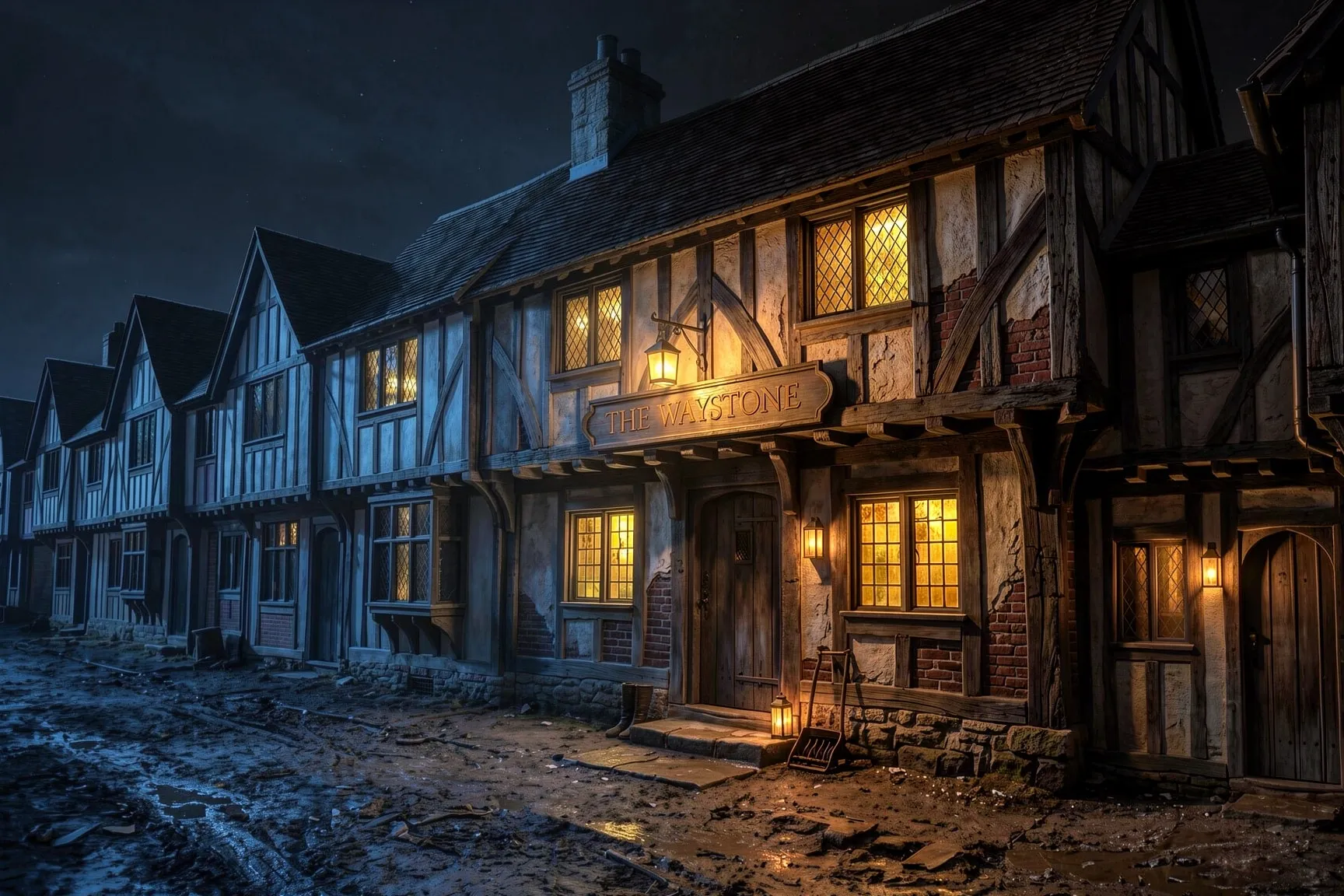
The Name of the Wind opens on an inn at night, and on what its author calls a silence of three parts. The first is the absence of ordinary noise. The second is a smaller silence made by the few men drinking there. The third belongs to the innkeeper, and is described, in the prologue’s last line, as the patient, cut-flower sound of a man who is waiting to die.
That is the whole book in one sentence, which arrives before the real story starts. A cut flower is not yet dead. It is alive and withering. Rothfuss put that image on page three and then spends two volumes walking back towards it. As yet, he has not arrived.
A trilogy can stop and be merely incomplete. A framed trilogy cannot. The frame has already shown you the ruined man and promised to explain the ruin.
What the frame was for
What Rothfuss actually built these novels around is a transcript. Kvothe, going by the name Kote, is hiding in a village inn and telling three days of his life to a scribe called Chronicler. Everything in the past tense is Kvothe’s account of himself, delivered by a man with obvious reasons to shape it in certain ways, and everything in the present tense is a small, sad story about an innkeeper who has lost all ability to wield a sword.
This does two things at once. It removes suspense about outcome, which is a loss, and replaces it with something rarer: the reader watching a distance closing-in. We know the boy becomes the man. We are waiting to learn what the boy did. And where it will go, from there.
It also converts the trilogy into a promise with a date on it. An unfinished trilogy is merely incomplete; you can shrug and say the road went on. A framed one cannot do that. The frame has already displayed the wreckage and undertaken to account for it, and until it does, the two existing books are not simply unfinished but unanswered, which is a arguably worse.
The sentence that has aged worst in modern fantasy
In March 2007, three weeks before The Name of the Wind was published, Rothfuss gave an interview to SFFWorld. He explained that he had written the whole thing as a single manuscript and that DAW had split it: “I wrote the whole thing as a single story. The hard part has been reshaping it slightly so that each novel is…well, novel shaped.”
Then he was asked how long readers would have to wait for books two and three.
“I’ve already written them. So you won’t have to wait forever for them to come out. They’ll be released on a regular schedule. One per year.”
He went further, and this is worth quoting in full because it is not a boast so much as a young writer’s entirely reasonable confidence: “You know the sophomore slump? When a writer’s second novel is weaker because they’re suddenly forced to write under deadline? I don’t have to worry about that because my next two novels are already good to go.”
The Wise Man’s Fear took four years and arrived on 1 March 2011, where it went straight to number one on the New York Times hardcover fiction list. The two published volumes have since sold upwards of ten million copies.
Nineteen years have now passed since he said the other two were already written. Fifteen have passed since the second one came out.
What happened?
Here’s a hint. A man who wrote one enormous manuscript in seven years of unbroken private freedom didn’t know that he was about to become a reviser rather than a drafter, and that revision is a process with no natural stopping point once several million people are waiting at the end of it.
The criticism, stated properly
There is a settled case against these books and it deserves setting out at its strongest rather than waved away, because a good deal of it is right.
Lisa Goldstein made it in Strange Horizons on 27 June 2011, and made it fairly, opening from the position that the book “is so entertaining, so much fun” that its problems bothered her less than they might have. Her objection was that “Kvothe is simply too good at too many things to be believable”: languages, the lute, sympathy, invention, all of it, all at once. Her second objection was diction. She flagged the moment where the narrator lists his course load and includes “comparative female anatomy” as an almost sly wink, and noted more broadly that characters speak like sarcastic undergraduates in a world that has no undergraduates of that kind.
The competence complaint has substance, and the reason is that Kvothe is narrating. He is a performer, a professional teller of his own legend, and a man with a strong interest in the version we receive. The reader is permitted (even invited) to hear vanity in this telling. Yet while that answer is structurally sound, fifteen years of silence has quietly disarmed it.
This is because an unreliable narrator is only unreliable if something eventually contradicts him. Until book three does that work, the defence is a promissory note like everything else here.
The complaint about sophomore vernacular has no such defence. It is simply true in places, and it sits oddly beside prose that elsewhere is very finely tuned indeed.
Then there is The Wise Man’s Fear itself, which is where the argument actually hits: a thousand pages in which Kvothe leaves the University, becomes a courtier, becomes a mercenary, spends a long sequence in the Fae with Felurian, and trains with the Adem. Readers who love the first book and cool on the second almost always name the same problem, and it is not prudishness. It is that the second volume loses the shape of the first. The Name of the Wind is a book about a poor boy trying to stay enrolled. Its stakes are tuition, firewood and a place to sleep, and its structure is one term of that. The second is an elevated journey through high courts and foreign planes of existence, with dangers far worse than a penalty from the Dean.
For many readers, myself included, it was delightful. But it’s easy to see where the difference in form happens and why it lost many who were probably hoping for another year of magical university education.
The man, and the decency owed him
Rothfuss has been unusually public about his mental health, in a genre where authors are not, and it is worth being careful about how that fact is used.
He has said the thing itself plainly. Talking to The Great Big Beautiful Podcast in 2018 he rejected the romantic diagnosis outright: “I don’t think writers’ block exists. I think undiagnosed mood disorder exists.” In May 2022 he wrote, in a short thread about why he keeps saying so, that he had not solved anything and then become a writer: “I didn’t fix my mental health, and, as a result, I became a success. (If anything, the opposite is true.) I battle. Present tense. Still fighting.”
I take him at his word, and so should everyone else. A reader is owed a book only when they have bought one. Nobody is owed the interior life of the person who wrote it, and the volume of abuse directed at this man over the years has been genuinely ugly and reflects on the people producing it rather than on him.
That said, there is one episode that is not a private matter, and pretending otherwise would be dishonest.
The chapter
Rothfuss founded Worldbuilders in 2008. It has raised over eleven and a half million dollars, most of it for Heifer International. That is an enormous amount of good done by a books charity built out of a fandom, and it should be the headline fact about his last decade.
In December 2021 the fundraiser ran on stretch goals, and he offered his own. Reach the first, and he would read the prologue of The Doors of Stone on stream. It was reached, and he did. Past that came a second, pegged at $333,333: a full, self-contained, spoiler-free chapter. That was met too, and then a third, for a narrated audio version with a cast of voice actors. The campaign finished at around $1.25 million.
Of a timetable, he wrote: “I’m pretty sure we’ll be able to get it done early next year. February at the latest.”
The chapter has never appeared. In April 2022 he said the audio production was moving more slowly than he would like. In 2023, on stream, he addressed it directly: “I feel really bad about the chapter. It got complicated and it got hard and various fires in my life […] meant I couldn’t keep it going, couldn’t put a bow on it, and I feel bad about it.”
I find I do not want to prosecute this, and I don’t think anyone should. What I will say is true, nonetheless: money was raised against a specific thing, by a man who proposed the thing himself, and the thing was not delivered, and four years later it still has not been. That is a statement about a transaction, not a person, and can be stated without contempt.
But it’s also, I suspect, the single clearest illustration of the bind he is in: he could not finish one chapter to his own satisfaction even with a deadline he set, an audience cheering, and a charitable cause on the other end of it.
What he has been doing instead
A great deal, and much of it lovely.
There have been two further books in the world: The Slow Regard of Silent Things in 2014, a novella about Auri with no plot and one character, which he prefaced with a foreword opening “You might not want to buy this book”; and The Narrow Road Between Desires in November 2023, an expansion of the earlier Bast story, illustrated by Nate Taylor. He made a board game, Tak, with James Ernest, lifted out of The Wise Man’s Fear, which is a real game that real people play. He streams. He runs the charity.
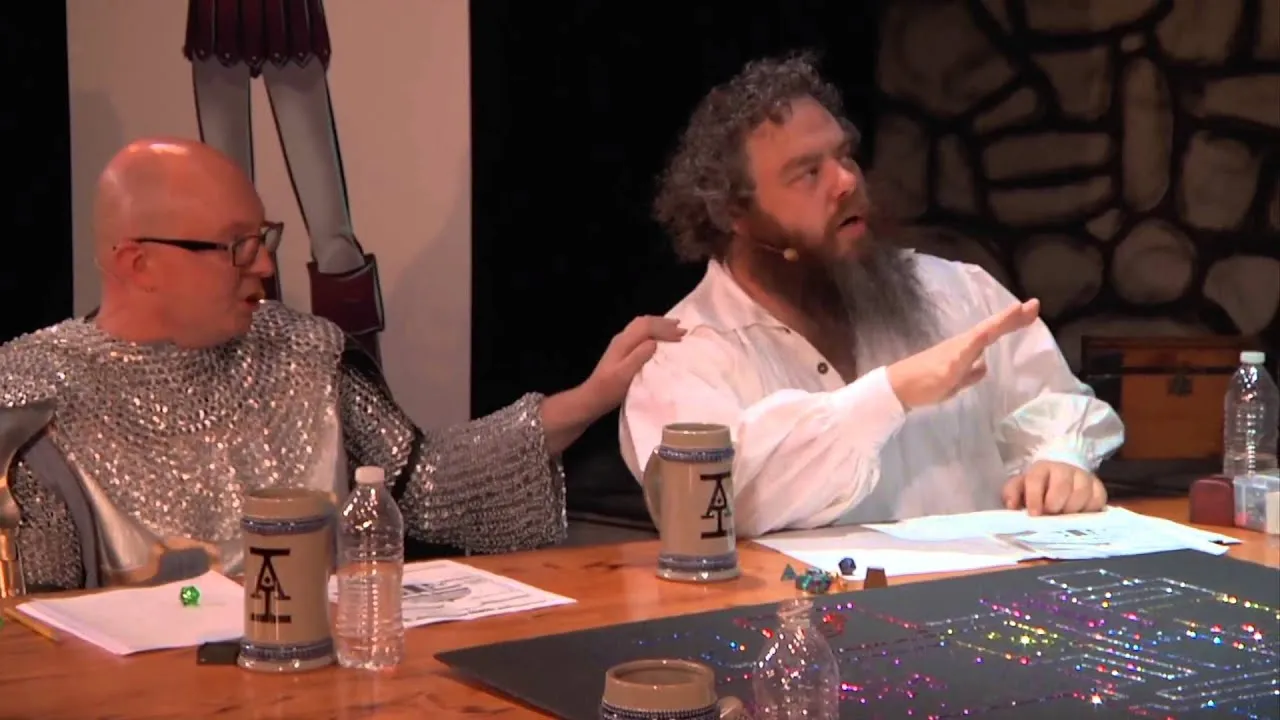
And he plays Dungeons and Dragons in public, which is where I would send anyone who has only ever encountered him as an argument.
As Viari in the Acquisitions Incorporated campaign, Rothfuss’s swashbuckling rogue has delighted us time and time again, live on stage in front of several thousand people at a time. He was Kerrek on Critical Role, a human paladin, first in episode 56 of the first campaign and then across a run of episodes in the eighties. He is superb at it. He is funny at the pace live comedy requires, he gives other players room, he commits to a bit without steering, and he can turn a scene warm in one sentence and then get out of the way.
It is not difficult to see what the table gives him that the page does not. At a table the story goes out live and cannot be revised. The sentence is spoken and it is finished, whether or not it was the best available sentence, and the game moves on. That is precisely the permission a perfectionist cannot grant himself alone in a room with a manuscript that ten million people are waiting for. This isn’t meant as a diagnosis, but an observation about where the work has gone, because it has plainly gone somewhere.
The screen, and why nobody has cracked it
We should talk about the adaptation history, because it’s thirteen years of very capable people failing at the same thing.
In July 2013, 20th Century Fox optioned the series with Eric Heisserer writing. That lapsed and the rights came back in 2015. Lionsgate acquired them in October 2017 with Lin-Manuel Miranda attached as producer and songwriter, and Showtime began developing a series the same month. Sam Raimi was in talks to direct the film in January 2018 and was reported off it by that December. Showtime passed in September 2019 and Lionsgate went out shopping with scripts already written.
In February 2022 Miranda confirmed on Variety’s awards podcast that he had gone too, and his exit line is the most useful sentence anyone has produced about this property: “We never cracked it. And I don’t know where it is, but my time on it kind of ran out, and I just was like, ‘I’m sorry I couldn’t get you any closer and help you figure out how this insane Russian nesting doll structure of a book becomes a movie or a TV show.’”
He is describing that core problem, again. And of course nobody cracked it. The nesting doll is the whole design, and the innermost doll has not been carved yet. An adapter can film the boy at the University, but the second they film the innkeeper they have to decide what he is waiting for, and no one on earth is authorised to decide that except the author. Every serious attempt has run into the same wall, and it is not a wall of money or of scale but simply of a story has not finished yet.
On rumours, briefly
Two things circulate perpetually and neither should move anybody.
The first is release dates. Retailer listings require a date, so retailer listings invent one; Amazon has carried several over the years, including one in August 2020, and each has come and gone. A date on a shop page is a database field, not an announcement. Treat any date not stated by Rothfuss or by DAW as noise.
The second is the “bloated, unpublishable” line, reported from a stop on Joe Abercrombie’s The Devils tour in May 2025, where Rothfuss appeared as a guest. The provenance is a single attendee posting afterwards, describing a joke told from a stage. It may well have been said. It tells us nothing about a manuscript, and treating a self-deprecating aside as a status report is exactly the interpretive habit that has made this whole conversation very unpleasant for so long.
What the shelf is for
I check doors for a living, now. It’s a habit I’ve picked up since I walked through one and found myself elsewhere. But I often think about what the intervening time has done. See, the thing nobody tells you about returning is that what you remember might have changed. The door works perfectly, but the person coming back through might not anymore.
Kote represents that problem. He is a man living inside the ruin of his own story, keeping an inn, polishing a bar, waiting. He is not blocked. He is finished, and knows it, and is passing the time. Here is a portrait of a person who cannot get back to being himself, written before its author had any way of understanding the irony: how long he would spend in a version of that room.
I do not think that is tragic and I would not dress it up as fate. Books are written by people, and people have years that do not produce books. But it does mean something for how we hold the two we have. A great many readers have spent fifteen years treating The Name of the Wind as an IOU. It is not one. It is a finished novel about a boy who wanted to learn the name of the wind and did, and it does not stop being that because the sequel to its sequel has not come.
The sequel, too, is still a wonderful read, and though I’m dying to understand the Chandrian and where all this goes, sometimes we just have to be happy with what we’ve got.
The shelf of unfinished things is not a shelf of failures. It is a shelf of good books that stopped, and they can be read on those terms, and they are still very fine.
Of course, if The Doors of Stone comes, I will be out there waiting to see what’s beyond those doors with everybody else. If it does not, the silence in the Waystone Inn will simply have turned out to be the real ending, which would be a bleaker piece of craft than anything Rothfuss ever put on the page, and, in its way, a perfect one.