



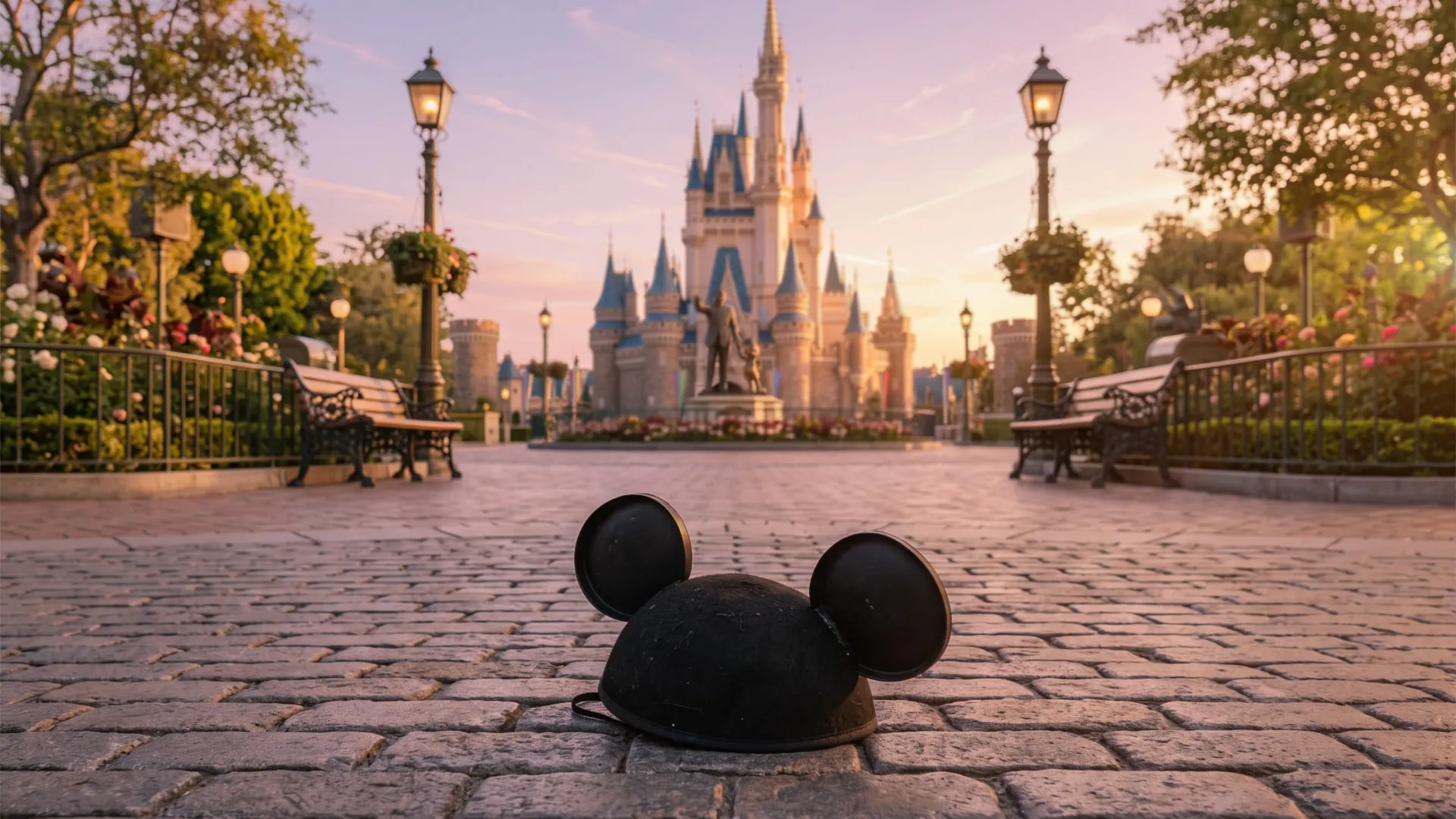
In a book, a door costs a sentence.
A wardrobe with no back to it, a rabbit hole, a painting of a ship, a green door in a white wall on a dull afternoon in West Kensington: the writer commits a line of prose and the reader does the rest, and the reason portal fiction works is that the transaction is almost free. Nobody has to build anything. Nobody has to pay for the other side.
Except that, in July 1955, in a former orange grove in Anaheim, one man did.
It was extensive in terms of money and property, and above the two tunnels at the entrance he hung a sign that has said the same thing every day since: Here you leave today and enter the world of yesterday, tomorrow and fantasy.
I have thought about that sign for most of my adult life, and I have come round to a position I did not expect to hold. Disneyland is not a portal in the sense I mean the word, and I will come to why. But it is the most serious attempt anybody in our history has made to build one on purpose, out of materials, at scale, for strangers, and I think we have got so used to it being a business that we have stopped noticing it is an achievement.
What it costs to mean it literally
It’s worth perusing the figures because in a way, that’s where the argument lives.
Construction began on 16 July 1954, and the park was dedicated on live television on 17 July 1955, opening to the public the following day. One year and one day, on a hundred and sixty acres, for a construction cost of seventeen million dollars (which is today around $211,8 million US).
It was financed on the strength of a drawing. Over a single weekend, 26 and 27 September 1953, the art director Herb Ryman sat at the studio with Walt Disney and produced a coloured map of a place that did not exist, so that Disney’s brother Roy could carry it to the ABC television executives in New York on the Monday and ask them for money. They gave him the money.
The opening was a disaster and is still remembered as Black Sunday. Something like 28,000 people came, and roughly half of them held counterfeit tickets. The asphalt was fresh and the day was hot and women’s heels went into it. Rides broke down. The restaurants ran out of food. Somebody had left the doors of the castle unlocked, so guests wandered in and discovered it was an empty shell.
I find this reassuring and humorous rather than otherwise. The idea Walt was offering was not carried by a flawless opening day, but by the idea, which survived an opening day that went wrong in every particular a day can go wrong in.
Afterwards, Walt learned from the disaster, and set about never having it happen again.
In a book, a door costs a sentence and never lives outside its margins. Here, somebody spent seventeen million dollars making it true.
The most expensive thing in the park is the part you cannot see
Go round the outside of Disneyland and you find an embankment of earth with a railway running along the top of it. It is called the berm, and it is one of the reasons the park works.
Its only function is to obscure a view of Anaheim. It does not carry a ride worth queueing for. It generates nothing. It is a wall of dirt built around a story, and the man who commissioned it said exactly why: “I don’t want the public to see the world they live in while they’re in the Park. I want them to feel they’re in another world.”
Here is why that is such a good idea. In fiction, the edge of the world is where writers cheat. The map runs out. There is a mist. There is a mountain range nobody has crossed and a polite agreement not to ask. I have read a great many secondary worlds and I can tell you that the border is almost always the weakest joinery in the building, because the author knows the reader will not (and cannot) push on it.
Disneyland pushed on it first, and then spent money on the answer. The edge of that world is a physical object, maintained daily, earning nothing, and every guest walks past it without once thinking about it, which is precisely the measure of how well it works.
One story at a time
The park’s interior follows a method which, unusually for this sort of thing, was written down with meticulous care and attention to detail.
In 1987 Marty Sklar, who ran Walt Disney Imagineering, set out the principles as Mickey’s Ten Commandments. Several of them are ordinary good sense about exhibitions. Three of them are, I think, a working theory of immersion that any novelist could use.
Create a weenie. This is Walt Disney’s own term, from the trick of getting a dog to follow you by holding up a sausage. It means a visual magnet at the end of a sightline: a castle at the far end of the street, so that you always know where you are going and always feel rewarded for arriving.
Tell one story at a time. Divide what you have to say into distinct, logical, organised stories, because people can only absorb one at once.
Avoid contradiction. Nothing in the world may argue with anything else in it.
That is why the lands are separate, and why they are laid out as a hub and five spokes rather than a circuit. You walk up Main Street to the castle, you choose a direction, you go into one world entirely, and then you come back to the middle before you go into another. It is the exact structure of a portal novel. The children go through the wardrobe, they have Narnia, they come back into the spare room, and the return is what makes the next going-in mean anything.
And the lands are as much emotions as they are places. Main Street is memory, assembled out of Walt Disney’s childhood in Marceline, Missouri and the designer Harper Goff’s in Fort Collins, Colorado, which means it is not a real town but a remembered one, and it is built accordingly. The ground floors are full size. The storeys above them shrink as they rise, so the buildings read as taller than they are and the street holds more than it can. Adventureland is the unknown. Frontierland is a national myth. Fantasyland is the storybook and Tomorrowland is the promise, and each of the five is committed to so completely that a member of staff dressed for one is not supposed to walk through another.
The ride that would not show you the heroine
There is a wrinkle in the story so small that most people have never heard it, and it revolves around one ride, Snow White and Her Adventures.
It opened with the park in 1955, and is a dark ride: you sit in a cart and you travel through the story. And in its original form, Snow White does not appear in it. Not once.
This was not an oversight or a saving. It was the design. You were not watching Snow White’s adventures. You were having them. The witch leans towards you. The forest closes on you. The reason the heroine is not in the ride is that the heroine is in the cart.
I want to be clear about how brilliant that is, because I have spent years writing about this form and I cannot name a rival. A novel cannot do it; even in the first person you are being told. A film cannot do it; the camera is somebody else’s eye and the protagonist is on the screen in front of you. Second-person fiction has tried and it mostly announces itself so loudly that you end up watching the technique instead. Here is an entertainment built for a general public in 1955 that simply removed its own main character on the grounds that you were her, and then said nothing about it.
The upshot is the human part, of course. Many guests came off the ride asking where Snow White was, and went on asking for years. Frustrating though that might have been for the ride’s designers and storytellers (otherwise known as Imagineers), in the Fantasyland rebuild of 1983 they finally gave in: the ride was reworked, renamed Snow White’s Scary Adventures, and Snow White was in it.
I do not read that as the illusion collapsing, and I would resist anybody who wanted to make it a smirking little story about magic being only paint. It is what happens when a door is public. A private door answers to nobody. A door with a ticket booth answers to the several million people a year holding tickets, and when a few million of them say they would like to see Snow White, a place that has organised itself entirely around the guest is going to show them Snow White. That is not a failure of nerve. It is the same instinct that built the thing.
What is remarkable is not the one concession. It is how few others there have been in seventy years.
The argument inside two rides
Something else in the method deserves saying, because it is a craft point and it applies directly to books.
The two attractions usually named as the high-water mark of the form, Pirates of the Caribbean in 1967 and the Haunted Mansion in 1969, were both made by two men who wanted different things. Claude Coats had been a background painter on Snow White and Fantasia, and what he wanted was atmosphere: light, architecture, dread, the slow build of a place. Marc Davis was a character animator, one of the studio’s finest, and what he wanted was jokes and personality and business.
What that disagreement produced, in Pirates, is a journey with a shape rather than a route. You get into a boat on a warm Louisiana evening, with fireflies over the water and somebody playing a banjo on a porch, and it is so unhurried that people forget they have joined a ride at all. Then the boat goes over two waterfalls, and the further down it carries you the older and colder the world becomes: a grotto, a wrecked ship, a beach where the skeletons are still holding their cards and their drink, and a voice remarking that dead men tell no tales. Only once you are thoroughly unsettled does the thing turn. You come up into a town being sacked, and it is riotous and shameless and very funny, and by the time the place is burning around you, you are laughing. Then the boat climbs a ramp and sets you down on the same warm evening you left, fifteen minutes later.
That is Claude Coats on the way down and Marc Davis on the way up, and the join is the whole point. You have not been shown a set. You have been taken down into the dark and brought back up out of it, which is the oldest shape a story has, and it is being performed on you by a boat.
The Mansion runs the same journey with the order reversed. It begins as a haunting: a gallery of portraits that stretch into grotesque scenes as the ceiling draws away, a corridor of doors that rattle and groan, a house that is plainly not pleased to have you in it. Then it opens into a ballroom where several dozen ghosts are waltzing and enjoying themselves enormously, and then a graveyard where they are having a considerably better night than the living are, and the last thing that happens is that one of them asks, with great courtesy, to come home with you. You arrive frightened and you leave invited. Neither man won that argument either. It was settled by a third, Xavier Atencio, who wrote the scripts and the songs and worked out that the two positions could be made into a structure instead of a compromise, so that the ride moves from dread into high spirits rather than choosing between them.
And the standard of finish underneath all this is the part I find hardest to credit. The Mansion’s exterior was completed in 1963 and the ride did not open until 12 August 1969, which means that for six years there stood in the park an immaculate, freshly painted house with absolutely nothing inside it. Walt Disney had refused to let it look derelict, and Coats remembered the instruction: “We’ll take care of the outside. The ghosts can take care of the inside.” A haunted house forbidden to look neglected sounds like a whim until you follow the reasoning, which is that a shabby building announces itself as a set, and a well-kept one says a family lives here.
Inside, the same care goes into things nobody is meant to notice. The ‘Doom Buggy’ you sit in is mounted so that it can be turned to any angle at any point along the track, which means the Imagineers decide where your head is pointing in every second of the ride. It is not a seat. It is a camera with a person in it, and it is why a ghost can appear behind you at precisely the moment you were might have been looking the other way. The dancers in the ballroom are done with Pepper’s Ghost, a Victorian stage illusion involving a large sheet of angled glass, which was a century old when they used it and remains the most famous use of the trick anywhere. Nothing is new for the sake of being new. Whatever serves the story is used, and then finished to a standard nobody was ever going to inspect.
The most interesting (some would say uncomfortable) evidence of that standard is in Pirates. When it opened in 1967, a number of the skeletons in the caves were real human remains, obtained from the anatomy department at UCLA, because the artificial ones available then were judged too unconvincing to use. Later, the company stated that they were replaced as the props improved and the remains returned for proper burial, though there are people who have looked hard at those caves and doubt that every one of them went. I set it down plainly because it is true and because it belongs in an honest account of how far these people would go for believability.
It is also worth more than any amount of theory about immersion. A world made by one sensibility with total control tends to come out airless. Disneyland was made by people who had to accommodate others they disagreed with, which is how the real world feels, and the result has outlasted almost everything made alongside it.
So is it a door?
Not in the sense you might think. And I want to say why carefully, because the honest answer is more generous than the flattering one would be.
It is not a door in the literary sense, because it gives you back. You come out at the end of the day through the same tunnel, and the world you left is exactly where you left it, and your car is in the car park where you parked it that morning. Nothing has cost you anything except money and the walk.
As someone who stepped through a door once and never found it again, I know the difference. A real portal is not generous. It does not consult you about the timing, it does not care what you were in the middle of, and it does not guarantee a return leg.
So: Disneyland is not that, and thank goodness. What it is, is the only door anyone has ever built deliberately, from nothing, out of concrete and paint and railway embankment and the stubbornness of a man who would not be told it was impossible, and which has since been walked through more than 750 million times, and every single one of those people got to come back out.
That is not the lesser thing. It is the kinder one. Portal fiction is full of children who cannot return and adults who cannot get back in, and the whole literature aches with it, and here is a version of the same idea engineered from the start so that nobody is lost and everybody gets to go home for tea. Given the alternative, I know which most would choose.
The sign is still over the tunnel. It has not been reworded once in seventy years, and I have never been able to decide whether the last three words are a description or an invitation. Yesterday, tomorrow and fantasy. He said the place would never be finished, that it would go on growing as long as there was imagination left in the world, which is either a very good piece of salesmanship or a promise, and I notice that it has been kept so far.
The door is still open. Most of them are not.