




The hard part of independent publishing is not the writing. Everyone assumes it is the writing.
The hard part is that a book which nobody has been told about is, functionally, a book that does not exist. There is no sales rep walking it into shops, no publicist placing it with reviewers, no co-op payment buying it a table by the door. Such is the life of an independently published novel: it arrives into total silence, and every single reader it acquires has to be acquired individually, by hand, usually by the author, usually in person.
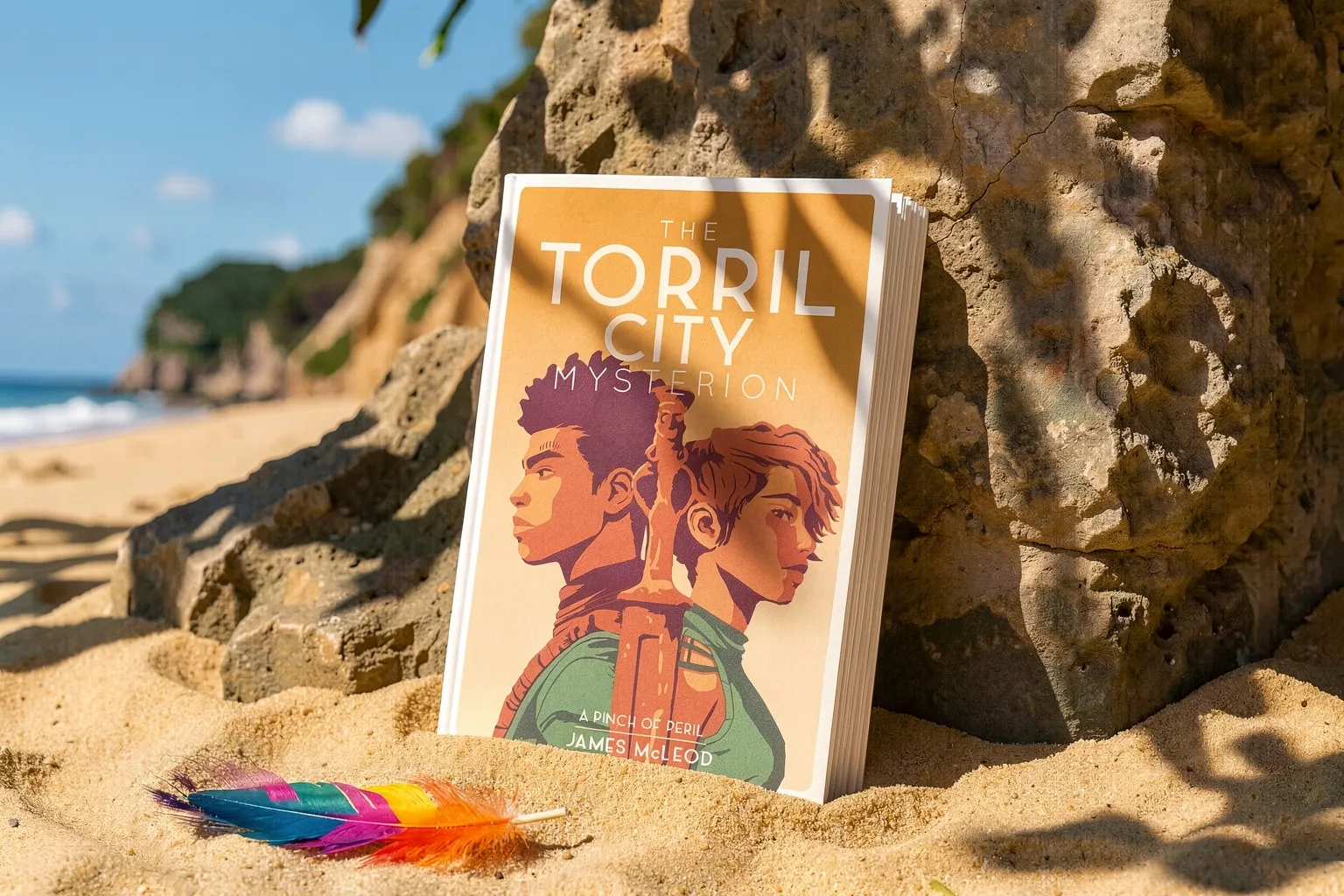
James McLeod has been doing that since 2021; turning up at indie book fairs with The Torril City Mysterion: A Pinch of Peril and talking to people one at a time. He is admirably unromantic about it. “Marketing is hard as night-iron to get right,” he has said, “but as with any labour of love, it’s something you stick at until it’s forged.”
Books like this one do not break out so much as accumulate, and the people who find them have a funny way of turning into advocates. That is a rarer outcome than a good review, and it usually means the book is doing something the reader could not get elsewhere.
I have now read it, cover to cover, and I can tell you what that something is.
He has not written an anti-fantasy novel. He has written a fantasy novel that quietly declines to inherit anything.
What has been thrown out
Start with the negative space, because that is where the argument lives.
There is no medieval Europe. There are no dragons, no elves, no fae courts. There is no farm boy, no prophecy, no sword in a stone, and (crucially) no war. The engine of the book is not a chosen one coming of age but a robbery: three artefacts taken from the city museum four days before a major exhibition, and a Bureau of Security that wants the matter closed quickly and quietly.
That is a police procedural. In a genre that reaches for the epic almost reflexively, McLeod has written a case.
He has been explicit about the intent, and the aim (in his own words) was to bring “some minty-freshness to a genre saturated in dragon-breath.” Authors who announce their intentions that plainly usually make a rod for their own backs, because a reader can then check. I checked. The dragon-breath really is absent, and what has been put in its place is not a gimmick.
Torril itself
The setting does the heaviest lifting, and the author’s own description of it is better than any summary I could write. Asked what Torril City is, McLeod replied: “Atlantis. If Atlantis were in a jungle, then throw some polynesian slash mongolian outfits into the equation, a bunch of white stone buildings, and fill it with birds.”
It’s therefore a terrestrial rainforest city, humid, sprawling, loud with birds, governed by an organisation called the Seat and administered by a thicket of Bureaus, in a world called Aliru. What matters is that it behaves. Municipal teams in green and brown work the streets full time, pulling weeds and clearing drains, because the jungle is actively trying to take the city back and would manage it in a season. Feathers are so abundant that they are a fashion staple; you simply pick them up. Coach fares are settled by touching one metal ingot to another. Someone is always cooking. Detail of that kind cannot be reverse-engineered from a map: it comes from having lived in the place long enough to know what its rubbish collection looks like.
The real invention is the accounting
The magic system gets described, quite reasonably, in terms of the Sharak, a personal otherworldly patron who can be petitioned and who may or may not oblige. If it does oblige, the results are routinely unpredictable. Magic is thus contingent on a relationship you maintain with an entity that has their own opinions about you, and that is a much better idea than it sounds. Post-Sanderson, the fashionable magic system is an engineering diagram: costed, ruled, predictable, and therefore essentially a physics with better branding. Reintroducing another party’s judgement puts back the one thing all that rigour designed out.
But having read the book, I think the Sharak is the advertised invention and just as important as its narrative counterpart; the ingot-belt.
Charge is held in small metal ingots worn at the waist. It depletes whether you use it or not. Every petition has a price, the Sharak names that price, and the price goes up the longer you leave it. Which means the characters spend the entire novel broke, or nearly broke, and making decisions about it. Our detective declines to ask for a second vision at a crime scene because he cannot afford one and may need the charge later; he loses an entire belt’s worth to a single corroded ingot that quietly drains its neighbours; he spends nine ingots on a crowd-control petition and has to justify it. Magic here is a current account with an overdraft, and a great many scenes are shaped by the balance.
That is the thing almost nobody does. It is easy to invent a magic system. It is hard to invent a magic economy and then actually live inside it for four hundred pages without cheating, and McLeod does not cheat. When the system finally pays out (and a Sharak, for the first time in the book, simply refuses a petition and will not say why) it lands, because we have watched the rules being obeyed for twenty chapters.
The two leads run on the same principle of partnership rather than hierarchy: Akteron Uusei Nisbri, a young detective for hire, and Piria Kii Kasbri, a scientifically minded pulvichist. Not master and apprentice. Not chosen one and mentor. Two professionals with different toolkits arguing about method. She wants to calculate, he wants to leap. This is the structure of every good detective story ever written and one fantasy has barely touched.
It is a detective novel, and it plays fair
This is the finding that most changed my view of the book, so I will be specific.
The central puzzle is a locked-room problem: the thief entered a sealed museum through a solid granite wall, two dashes thick, and the solution (sorry, no spoilers here!) is properly clued. Though one might pass over these clues early on, when the answer finally comes it tickles that part of the brain that insists it put things together itself. In other words; nothing is withheld from the reader that is not withheld from the detectives.
The same discipline holds elsewhere. A handful of odd granules collected on a rooftop sit in a coat pocket for a third of the book before becoming useful. And the closing turn (which I will not spoil beyond saying that the case is solved and then quietly comes apart in the last twenty pages) depends on a date the museum’s curator states out loud in chapter three, in a lecture the reader is entitled to find tedious at the time. It is a clue disguised as exposition, planted twenty chapters early, and it is exact.
I have read a good deal of adult fantasy that could not manage that. It is the strongest thing in the book and it is the part least likely to be noticed, because plot construction is invisible when it works.
The bell
The best single invention deserves its own paragraph. One of the stolen relics is the Bell of Tongues, which strips those in earshot of the ability to communicate. The obvious version of that idea is a bell that takes away speech. McLeod’s version takes away all of it; writing, gesture, facial expression, the lot. And the chapter in which the detectives walk through an entire district of people who cannot make themselves understood by any means whatsoever is the most unsettling stretch of the novel. Two scholars stand under a lamp-post, look at their books, and try semaphore. It does not work. A man performs a small bow at strangers because it is all he has left.
That is a genuinely good idea, and it is the moment the book’s insistence that these objects are dangerous stops being an assertion and becomes a demonstration.
Human, and it shows
The copyright page carries a line I have not seen in a novel before: “This is a human work. No part of this book nor ideas in it were generated by an AI.” McLeod says the same on his website.
I record it because it is a fact about the book’s provenance and readers may reasonably want to know it. I will not turn it into a sermon but what I will say is that the internal evidence agrees with the claim, if only in a slightly backhanded way, because the tells are the imperfections. A character’s name drifts between two spellings across a hundred pages. A specialist term appears in two forms. Jokes are made that no averaging process would arrive at, about house-slippers and cheese and a god of alcohol. The book has an editor (she is thanked warmly) and it has still been touched by a person all the way through, in the way that leaves fingerprints. Provenance, here, is not a marketing claim, but legible in the prose.
Where it wobbles
Now the granary inspection, because a review that only reports the good news is not a review.
The prose is unbalanced. It is clean, it is readable, and at intervals it is genuinely fine, (the sequence in which our detective is pulled bodily into his Sharak’s mind-space is the best writing in the book by some distance). But it is not yet polished.
A notable exception is the city itself. When McLeod describes Torril, it’s as if he stops writing and starts observing: the rainforest leaning in at the edges, the wet heat, the white stone, the birds, the racket. He never over-decorates that material, presumably because he does not have to, and the prose gleams softly like buffed limestone in the sun.
This is not a feature I alone have noticed. One review on Goodreads notes that Torril “really feels like a city that has existed long before I ever started reading about it.” Another picks out the word “avifauna (definitely a word I learned reading this book…)”. While another says reading the work is like discovering “a sense of long lived history and mystery.”
Clearly, this is an author’s affection for his own invention coming through the page, and it is always distinguishable from a setting that has merely been specified. At times it honestly feels like one is taking a tour through a city he has visited personally, while wildlife is written the way people write about birds they have actually stood and watched.
Still, the prose reaches for a flourish too often, with a few too many adjectives for comfort. The invented oaths are a nice touch at one per page and a tic at four; by the second act “Great Wastes” and “Beaks in the night” have stopped carrying weight. McLeod’s (clear) choice to have sound effects set off in capitals between dashes might suit a thirteen-year-old reader or a comic panel, but I found it undercuts two or three scenes that would otherwise have been more impactful without. Personal taste, perhaps.
The middle sags. There are stretches; a long walk to a clothier, a chapter spent extracting a confession from a market charlatan, that are enjoyable in themselves and recap material the reader already has. They build the world admirably, but the book is twenty-three chapters and an epilogue and would be a harder, faster novel at twenty. Readers acclimatised to Sanderson’s extended romps through pages of Shadesmar may not find it a problem.
The best invention is the least used. An order of deaf, plant-grafted keepers living in a buried city beneath Torril, in communion with the consciousness of nature itself, is one of the more startling things McLeod has built. It’s a culture that exists alongside Torril’s ‘overworld’ but remains hidden for reasons they touch on, and which I’d like to see expanded. In A Pinch of Peril, they appear once, perform a function, and depart, and while I harbour a deep suspicion we’ll see them again, in a book otherwise scrupulous about making its leads earn everything, this felt like untapped potential.
What it is for, and what it is worth
Two things must be said plainly before the verdict, because they change what the verdict means.
As a first novel, The Torril City Mysterion, A Pinch of Peril is a solid debut. Yet it does still feel like a debut. Readers who are already immersed in the genre’s more leviathan constituents may find it slightly lacking in epic tone or complex political theorising.
It is also written for ages thirteen plus. That is not a discount; it is a specification. The register, (the sound effects, the running food jokes, the trivia contest staged as a set piece), is calibrated for that reader, and a critic who marks it down for not sounding like a novel for forty-year-olds has simply reviewed the wrong book. Where the age band does bear on the judgement is that the novel takes its readers seriously: it has adult themes running alongside the kind-hearted banter, like the disorientation of loss, or suicide, or a colonised character policing on behalf of the occupying power. McLeod does not simplify what that costs said character, nor does he moralise about it. Such things are (at least in this first episode) left to the reader to muse upon.
This was, admittedly, somewhat surprising, for there are a good deal of books out there nowadays that seem to be using their narratives as backdoors to sneak a speech about this or that current social or political view into the reader’s ear. McLeod avoids that, and I honestly found it most refreshing.
Which leads me to the protagonists. Reading the (admittedly scant) reviews out there, one has to conclude that if there’s one thing readers are enjoying perhaps more than the magic system, the city, or the plot itself, it’s Akteron and Piria, both of whom are excellently designed and written. They don’t compete, or argue (really), or try to judge one another. They just get along. One gets the sense that both of these characters, who differ vastly in certain areas, not only genuinely enjoy each other’s company but work together to get things done. Like with the city, one sometimes has the feeling of having stumbled into something real, dropping into their living room to eavesdrop as they discuss cheese or their frustrations with work.
Four quills, and I will say why it is not five. Five would mean the sentences were as good as the structure, and they are not yet; the plotting here is the work of someone in full command, and the prose is the work of someone still slightly over-supplying. That gap is the most ordinary thing in the world in a first novel and the easiest to close.
It is also not three. Three would badly undersell how much of this actually works: a magic system with a functioning economy, a mystery that plays fair across four hundred pages, a jungle city that behaves like a real municipality, and a partnership between two adults who genuinely like each other.
The door left open
One warning for anyone starting now. The case closes and then, in the final chapter, unlatches. The book ends on a genuine hook; a name unspoken, an epilogue that recruits a minor character into something much larger, and it is the first of a planned four. Book one took nearly three years. Anyone settling in should settle in properly.
That is a real cost, and so is the rest of the argument. A reader looking for dragons will not find them. A reader looking for a familiar shape will have to do more work than a mass-market fantasy usually asks, and will be met at the stall by an author explaining, one person at a time, why that is worth it.
So when people call this a “fresh new turn for fantasy,” they are responding to something real. Somebody sat down, looked at the standard-issue components (the pseudo-Europe, the escalating war, the magic-as-engineering, the boy with the destiny) declined all of them at once, and then did the considerably harder work of building replacements that hold together.
They hold. That is the news. Judged the way I judge any novel; by whether it will still be standing after a hard winter. I believe this one will.