
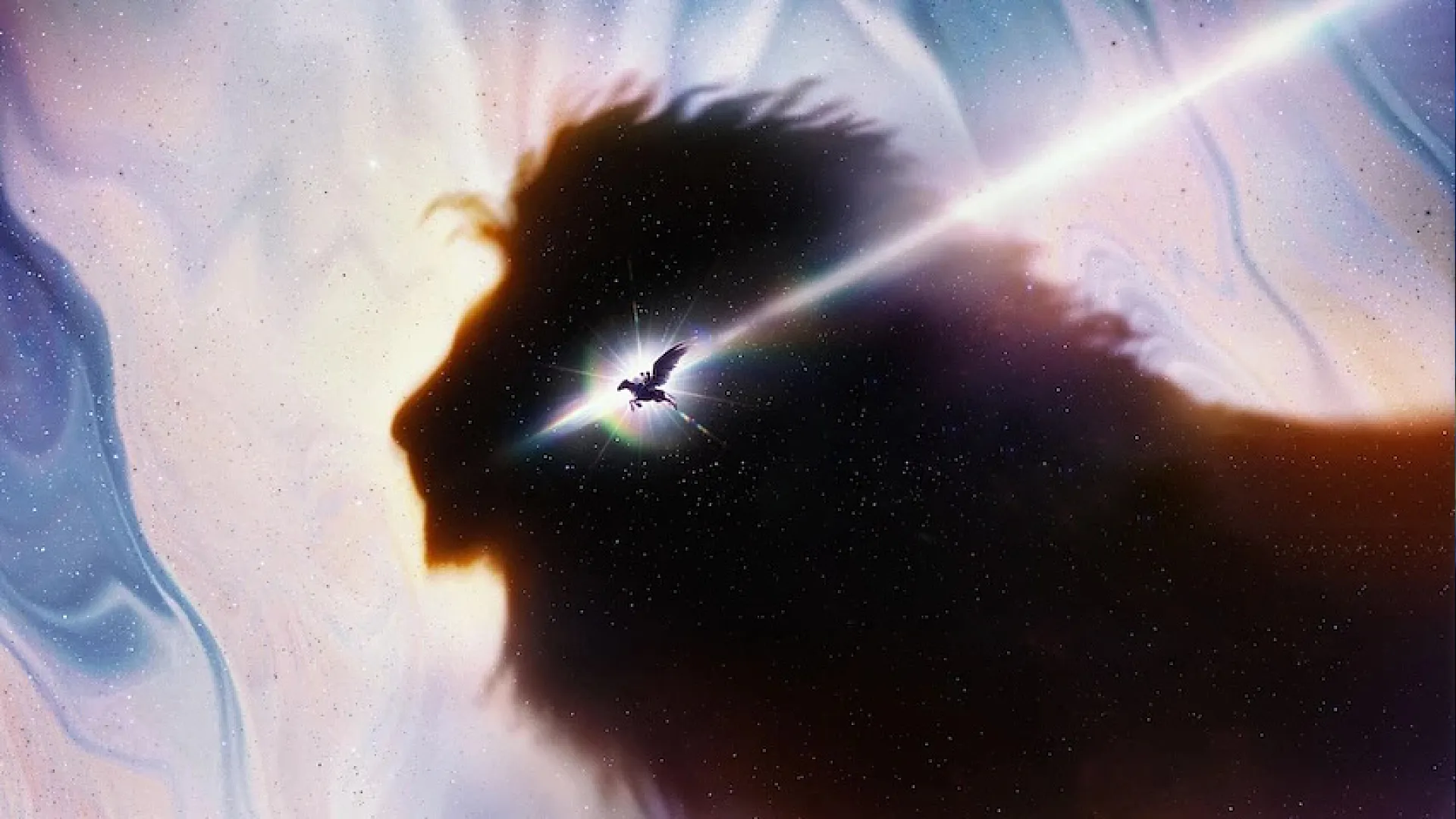
Near the end of the first trailer for Narnia: The Magician’s Nephew, a lion gathers itself out of stardust in the dark, lifts its head, and roars.
Netflix released the trailer on 13 October. It opens on a carved wooden wardrobe, which is a little like beginning a film about a famous old man’s boyhood with a shot of his walking stick, and it is set to “Stairway to Heaven”, a song Led Zeppelin very seldom allow anybody to use. Then it gives us the book, or most of it, at speed: two children in a London attic, an uncle with a glowing study and a box of rings, a wood full of still pools, a dead city under a dying red sun, a woman waking in a ruined palace, a rampage through London, a winged horse over green country, a witch in white in an icy wood, and at the end the lion, made of stars, roaring.
The Magician’s Nephew was published in 1955. It was the sixth of C.S. Lewis’s seven Chronicles of Narnia to appear, and it is the first in the history of the world they describe. Digory Kirke and Polly Plummer are two children in a London terrace whose Uncle Andrew, a vain and cowardly dabbler in magic, sends them out of the world with a pair of enchanted rings. They find the Wood Between the Worlds, a quiet place of pools, each of which leads somewhere else; the dead city of Charn, where Digory wakes the terrible Queen Jadis; and at last an empty darkness, in which a lion is about to make a world. Jadis, who follows them there, will become the White Witch of The Lion, the Witch and the Wardrobe. Digory will grow up to be the old Professor in whose wardrobe the Pevensie children hide. This is the book that tells you how the wardrobe came to be what it is.
The voice of the lion
In August I wrote here that a great deal of argument had attached itself to a casting nobody had confirmed. It has been confirmed now: in September Empire magazine put Gerwig’s lion on its cover and said it plainly, Meryl Streep voices Aslan.
Gerwig has given her reasons. “I wanted someone who was profound but not pretentious, who had gravitas but not morose self-seriousness,” she told the magazine. She wanted somebody over seventy, she said, “so there was a wisdom of experience”, but “who also had the capacity of fresh wonder, like a child”, and “one of the greatest actors to ever do it. That list is not a long one.”
All of that is true of Streep, and none of it was ever in question; the difficulty I described in August was never about talent. What Gerwig has not done, in any interview I can find, is answer the obvious question, which is why the voice of Lewis’s lion needed to be a woman’s at all. When she showed the trailer to an audience in New York on 13 October the casting did not come up, and Cameron Strang of RELEVANT, a Christian magazine, who was in the room, noticed that she called Aslan “he” throughout. The trailer, meanwhile, lets the lion roar and never lets him speak, and Netflix has said nothing at all. The likeliest reason for all that care is the obvious one: an audience will hear Aslan for the first time when it is already in its seats, and has already paid.
Lewis saw this coming in August 1948 when, arguing in the weekly review Time and Tide against the ordination of women in the Church of England, he imagined almost exactly this move and followed it to its end. “Suppose the reformer stops saying that a good woman may be like God and begins saying that God is like a good woman,” he wrote. Suppose we pray to “Our Mother which art in heaven”; suppose “the Incarnation might just as well have taken a female as a male form”. His conclusion was blunt: “if all these supposals were ever carried into effect we should be embarked on a different religion.” He did not think the masculine images of God were decoration that a later age might repaint to its taste, because, as he put it, “image and apprehension cleave closer together than common sense is here prepared to admit.”
Aslan is that conviction in a lion’s shape, Lewis’s answer to what Christ might become like if there really were a world like Narnia. In a film, where the lion is built out of pixels, the voice is the only body he has. Keep him “he” in the script and give him a woman’s voice, and when God speaks in Narnia what the audience actually hears is a woman. That is not a compromise between the two readings; it is the one choice certain to make the question the first thing anybody notices.
In a film, where the lion is built out of pixels, the voice is the only body he has.
This was not an accident of who happened to be free. “That list is not a long one,” Gerwig said, and she went looking for the name to play the lion. Nor is she a director who comes to a classic without an argument of her own. When she adapted Little Women in 2019 she rewrote its ending, because, she told Film Comment, “I just knew I could not do the ending just as the book” did: Louisa May Alcott had not wanted Jo to marry, and “if we can’t give her an ending she would like, 150 years later, then what have we done? We’ve made no progress.” She could not write the book’s version in good faith, she said, because “it’s not in me.” Her Barbie, the highest-grossing film of 2023, is a comedy built on an argument about the sexes, and while she was making it she remarked to Vogue that Ken “was invented after Barbie, to burnish Barbie’s position in our eyes and in the world”, and that “that kind of creation myth is the opposite of the creation myth in Genesis.” In other interviews about faith and Christianity, Gerwig has stated that hearing phrases like “Jesus Christ is my Lord and Savior” is “creepy”.
The Magician’s Nephew is Lewis’s Genesis: a world sung into being, a garden, an apple, and a witch who urges a child to eat what he has been told to leave alone.
The Little Women change was made in the name of Alcott’s own wishes, which is exactly the difficulty. By the standard Gerwig applied there, an author’s known wishes outrank the letter of the text, and Lewis’s wishes about how God is to be imaged are on the record, in his own hand, and they run the other way. Gerwig has said she wrote the script trying “to align myself with where Lewis’ soul was.” On this point Lewis’s soul left very clear directions, and the film has not followed them.
It is also hard to see what was gained. The Magician’s Nephew is not a book short of women. Polly Plummer is Digory’s equal in it and usually the more sensible of the two; Jadis is the most memorable villain Lewis ever wrote; Digory’s dying mother is the reason for the whole quest; and when the cabby is crowned the first King of Narnia, his wife Helen is crowned beside him as its first Queen. The film has Beatrice Campbell, Emma Mackey and Carey Mulligan among its leads.
The choice therefore says something, and what it says belongs to the director rather than to the author. It is hard to read it as anything other than a director setting her own argument on the one figure in the book that was never hers to rewrite. Nowadays, classic books have been reinterpreted, reimagined and adjusted for a modern audience so often that a reader may be forgiven for having stopped expecting anything else. I had hoped, given everything Gerwig has said about loving these books (“These books created me,” she told the audience in New York), that this would be the exception. On the evidence of this decision, it is not.
The other changes
There are plenty of other changes, and they are likely just as contentious.
Firstly, the lion’s face has a bold red stripe and the eyes are two different colours, which Empire describes as a nod to David Bowie, one of Gerwig’s great inspirations. (“David Bowie saved my life,” she told the magazine.) She has said she wanted “a rock opera”, something “big and transporting”, and the trailer shows what that means for Jadis, who wakes in Charn wearing what one close reading of the footage called a disco-inspired, glam-rock dress, in a room lined with strips of neon. This is not Lewis’s Charn, which is silent and enormous and very old, and held in that silence a whisper of warning. A threat. A malignance, waiting to be awoken.
But this change is not confined to Charn. There is a clear style to the other fantastical scenes, which many viewers of the trailer have quipped look more like ‘Narnia of the Galaxy’ or ‘Narnia, Love and Thunder’ than the adaption they had envisaged. This change may look exhilarating to some, but a few commentators like YouTube reviewer JesterBell have questioned why Jadis, Queen of Charn looks “like Katy Perry [in] a metal skirt”, and why the aesthetic appears “like every other forgettable […] fantasy movie that came after the 2000s?”
The trailer appears to show Jadis loosing her magic on London. In the book she cannot. Her spells fail in our world (she tries one on Digory’s Aunt Letty, and nothing whatever happens), yet she is terrifying in London anyway, because she is enormously strong: she takes a hansom cab, robs a jeweller’s and wrenches an iron bar off a lamp-post to fight the police with. That bar, flung at the Lion in Narnia, falls into the new soil and grows into the lamp-post that Lucy will one day find in the snow. A trailer compresses everything, and this may not be what the film does. But the London chapters are the comedy of the book, and the lamp-post is one of its best jokes about where things come from, and it seems that joke has been exchanged for more spectacle.
The change that represents perhaps the final greatest discrepancy, however, is the date.
The book’s narrator places the story “long ago when your grandfather was a child”, in the days when Sherlock Holmes was still living in Baker Street: that is to say, about 1900. Gerwig has moved it to the 1950s, and her reason is the most moving thing anybody involved has said about the film. She was thinking of the children of postwar Britain, playing among the ruins left by the bombing. “They had this relationship to pain and loss and something as unpromising as a bomb site,” she said, “and they made a castle.”
Perhaps Lewis would have understood this change, at least. On 2 September 1939 three schoolgirls evacuated from London came to live at his house outside Oxford, and before the month was out he had begun a children’s story about four siblings sent from London to an old professor’s house in the country. The 1950s are also the decade in which The Magician’s Nephew was published. The film has moved the story into its author’s own present, which is not a bad place to put a story about beginnings.
Even so, the move costs something, and it costs it in the place where the book is most tender.
Lewis kept a private outline of Narnian history, and in it Digory and Polly’s adventure falls in 1900, while the Pevensies arrive at the Professor’s house in 1940. Forty years lie between the boy who plants an apple core in a London garden and the old man who owns a wardrobe made from the tree that grew out of it. That distance is the whole sweetness of the connection, because Digory had to grow old before the door he made could open for anybody else.
I have done some chin-scratching over that arithmetic. A Digory who is a boy in the 1950s cannot be the old man of 1940, so either the films mean to move the wardrobe too, or that thread has been cut, and while neither would be a disaster, the second would be a real loss.
The song
In the end the film will be judged less on its calendar or its lamp-post than on the trailer’s last image.
In the book the creation of Narnia is not a roar. “In the darkness something was happening at last,” Lewis writes. “A voice had begun to sing.” Digory thinks it the most beautiful noise he has ever heard. Other voices join it, higher and silvery, and as they do the stars come out. Then the sun rises on an empty land, and the singer is a Lion, pacing to and fro, and as his song changes the land changes with it: grass, then trees and flowers, then the animals climbing up out of the earth. Polly begins to see the connection between the music and the things being made.
And one person present cannot bear it. Uncle Andrew, who brought them all there by his meddling, hears the song and hates it, because it makes him “think and feel things he did not want to think and feel.” So he tells himself that it is only an animal roaring, and the harder he tries to believe that he can hear “nothing but roaring”, the easier it becomes, until that is all he can hear. Lewis explains it in a sentence many readers carry with them for the rest of their lives: “For what you see and hear depends a good deal on where you are standing: it also depends on what sort of person you are.” Near the end of the book Aslan says that if he spoke to Uncle Andrew, “he would hear only growlings and roarings.”
In the book, only one person present hears the creation of Narnia as roaring, and Lewis is very clear about what sort of person he is.
So the trailer gives us the roar and keeps the voice back, for the reason already given, and whether by design or not, nobody can judge a song from an advertisement that does not play it. But Gerwig clearly understands the weight of audio, and music in particular, for she has also stated: “Narnia is literally a world made out of music.” To that end, she is once more working with composers Mark Ronson and Andrew Wyatt, who scored her Barbie and share an Academy Award for “Shallow”, the song they wrote with Lady Gaga and Anthony Rossomando for A Star Is Born. In short: they know how to write something that makes a room sit forward. Whether all of that sound will fit the soul of this story is, again, up in the air. But anyone hoping for a score full of whimsy and wonder should probably leave that expectation at the door, and buckle up for some 80s glam rock instead.
The lion in the firelight
One last observation that feels pertinent here.
In The Last Battle, the seventh and final Chronicle, published in 1956, Lewis writes of a clever and greedy ape called Shift who finds the skin of a lion, ties it onto his trusting friend Puzzle, a donkey, and shows him to the Narnians as Aslan come back. The idea is an old one, borrowed from Aesop’s fable of the ass in the lion’s skin, in one telling of which the disguise holds until the ass opens its mouth and a fox tells it: “I might possibly have been frightened myself, if I had not heard your bray.”
Lewis is exact about when such a trick can work. “No one who had ever seen a real lion would have been taken in for a moment,” he writes, adding that a stranger to lions might be fooled if he did not come too close, “and if the light was not too good, and if Puzzle didn’t let out a bray.”
So Shift’s lion is shown only at night, by firelight, and it stands and says nothing while the ape speaks for it. Tirian, the last king of Narnia, who has loved Aslan all his life without ever having seen him, looks at it and cannot be sure; he had not expected Aslan to look like “that stiff thing which stood and said nothing.” Jill Pole, a girl from our world who has met the real Lion, can say what Tirian cannot: “But I’ve seen him.”
The harm outlasts the trick. The small creatures who have been shown the thing by firelight are not so much converted as heartbroken: “We didn’t think Aslan would be like that,” a mouse tells Tirian in the night. And when Tirian shows a band of Dwarfs the donkey behind the mask, sure that they will rally to him the moment they see how they have been deceived, he learns that “one of the results of an Ape’s setting up a false Aslan would be to stop people from believing in the real one.” Having been fooled once, the Dwarfs resolve to believe in nobody, and from then on the Dwarfs are for the Dwarfs.
The comparison could be made cruelly, and I will not make it that way: Meryl Streep is one of the finest actors alive, and nobody is accusing Gerwig of a Shift’s swindle. Yet the irony is too plain to pass over. The last of the books Gerwig says created her is about the harm done when Narnia is shown a lion that is not quite Aslan, and in it Lewis is clear that the test was never the size of the lion, or the fame of whoever is under the skin. The test was whether those who had known the real one would recognise him, and among the things Lewis says would give a false one away is the sound it makes. Gerwig has said she wrote her script trying to align herself with where Lewis’s soul was. The choice of this voice is hers as well, and the two do not sit easily together.
So, when the cinema goes dark and that voice begins, a room full of people who grew up on these books will be doing what Tirian did by the firelight, listening for a Lion they know. For a great many of the children sitting beside them it will be their first meeting with Aslan, and Lewis’s mice are a reminder of what it costs when the Aslan people are shown is not the Aslan of the stories.
The film opens in cinemas on 12 February, with IMAX previews from the 10th, and comes to Netflix on 2 April. It will be the first film Netflix has released widely in cinemas.